

In this complete guide to visiting Arenal Volcano, you’ll discover what makes this Costa Rica highlight unique, what it offers to adventure seekers, and how to make the most of your stay.
Costa Rica’s most famous active volcano is arguably what put the country on the tourist radar all those moons ago. Today, it’s the surrounding natural splendors, the impressive array of outdoor adventures, and the convenience of the quaint little town of La Fortuna that keeps the tourists flowing in.
Arenal is to Costa Rica what the Eiffel Tower is to Paris: an unmissable highlight you wouldn’t dream of skipping. Not only on your first visit but on EVERY visit to the country.
Plan Your Arenal Adventure Today!
Here’s all you need to know about the jaw-dropping Arenal Volcano!
Arenal Volcano at a Glance
Planning a visit becomes significantly easier when the basics are clear from the start. Here is a quick reference snapshot before diving into the full guide.
- Location: Northern lowlands of Costa Rica, Alajuela Province, approximately 148 kilometers (92 miles) northwest of San José and about 15 kilometers southwest of La Fortuna.
- Park Size: 12,080 hectares (29,850 acres) of protected rainforest, lava fields, and volcanic landscape, established in 1991 and managed by SINAC (National System of Conservation Areas).
- Volcano Elevation: 1,657 meters (5,437 feet) above sea level.
- Volcano Type: Andesitic stratovolcano. Highly active from 1968 until 2010, currently in a dormant phase but still geologically alive.
- Average Temperature: 21°C to 27°C (70°F to 80°F) year-round.
- Average Annual Rainfall: Approximately 3,490 mm (138 inches). Rain gear is always a wise addition to the pack regardless of the season.
- Overnight Facilities Inside the Park: None. All accommodation is in La Fortuna or the surrounding hotel zone.
What is the best base for visiting Arenal Volcano?
The tiny hamlet of La Fortuna is the revered springboard for visits to Arenal. The charming town is home to 15,000 residents but welcomes millions of visitors, every year. It sits in the central lowlands, about 100 miles northwest of San Jose, the country’s capital.
Look, right here…
And here’s a closer overview of the town and its immediate surroundings…
As you can see, La Fortuna really is the heart and soul of Arenal adventures.
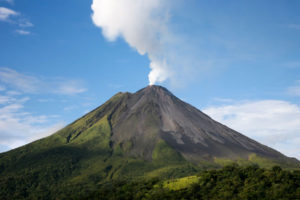 The town was first founded in the 1930s as a farming hub and quickly became popular, and renamed ‘The Fortune’, thanks to its immensely fertile lands. Arenal’s catastrophic eruption of 1968 alienated everything within a 10-mile radius and reshaped the landscape. As a consequence, it created what is now considered to be the single most jaw-dropping natural highlight in all of Costa Rica.
La Fortuna sits just 6 miles from Arenal Volcano although, as a visitor, you need not worry about impending eruptions. Despite this being ranked among the world’s 20 most active volcanoes, Arenal has not threatened to erupt in a big way since 1968 and has been declared dormant since 2010. Mind you, this stunning peak still puts on a spectacular show now and then. After dark, you can see slow-moving lava cascading from the active western side, and smoke is often visible during the day. Local experts are on the ball and strict safety guidelines are in place, limiting how close visitors can get.
Hiking trails abound and afford magnificent views of the volcano and night-time lava spectacles. At the slightest hint of a rumble, trails are closed to hikers but this isn’t something that happens very often.
It’s easy to see why Arenal is the country’s foremost attraction (it is a picture-perfect peak, after all) although you’ll be astounded to discover just how many volcanoes there are – not only in this immediate region but throughout Costa Rica!
Find out which Costa Rica volcanoes you can climb.
The Best Places To Stay When Visiting Arenal Volcano
Being such a popular tourist hub means La Fortuna boasts a wide range of accommodation options to suit all budgets – from inexpensive guesthouses to eye-popping luxury resorts. Naturally, many people opt to splurge when visiting Arenal.
After all, waking up to a spectacular view of the volcano is a once-in-a-lifetime experience no one forgets in a hurry.
 The best hotels in Arenal also boast their own hot springs. Being a volcanic region, Arenal and La Fortuna offer an abundance of natural thermal pools.
The perfect antidote to aching muscles after a full day of adrenaline-pumping adventures, Arenal’s therapeutic hot springs are divine!
Find out more about the amazing hot spring resorts in Arenal and La Fortuna – you’ll discover they come in a range of budget options. These are the top 12 Arenal hotels we can highly recommend for your visit.
What you should know before visiting Arenal Volcano
 SIZE: The Arenal Conservation Area covers a mind-boggling 504,000 acres of spectacular wilderness, protecting over a dozen distinct reserves. The volcano itself, stunning as it is at over 5,300”, is just one of the many biological and geological highlights to discover. Nearby Arenal is Chato Volcano and its amazing collapsed caldera, for example, which is now the lagoon that feeds La Fortuna waterfall.
TIME NEEDED: The sheer size of the Arenal area and the complexity of its landscapes translates into a near-endless array of activities on offer. Most visitors will dedicate two or three days to their Arenal visit although, in all honesty, you can easily fill a whole week with outstanding adventures.
WHAT TO PACK: As with almost all destinations in Costa Rica, you need to pack for all eventualities. Include functional outdoor clothing, rain gear, good hiking boots, insect repellent, and sunscreen, no matter the time of year. Don’t forget to pack your bathers and plenty of waterproof bags for activities like rafting, kayaking, and waterfall chasing!
BEST TIME TO VISIT: The Green Season, which runs from May to October, is a phenomenal time to visit Arenal and Costa Rica in general. This is the rain(ier) season that keeps many tourists away. That means everything is quieter and cheaper although cloudy skies ensure the peak of Arenal is pretty much shrouded in mist for days on end. Many will surmise that the dry season (Dec-April) gifts better chances of crystal-clear views of Arenal, but you should know that the peak of the volcano is shrouded in cloud for most of the year. It really is the luck of the draw so, from our viewpoint, the best time to visit Arenal is anytime you can get here! Arenal is an unforgettable sight, every single time.
Besides… the rainy season is the best whitewater rafting and kayaking season so if that’s the prime reason for visiting, don’t let a few clouds deter you.
BE AN EARLY BIRD: For the best chances of seeing the peak of Arenal in all its cloudless glory, get into the habit of waking up at sunrise. This is perhaps the best reason to stay in a lodge or resort with a stellar view of the volcano.
DON’T SUFFER FOMO: If you arrive in La Fortuna and Arenal without having any activity booked, you will likely be overwhelmed by the array of stuff on offer and waste a lot of precious time deciding what to do first (and second and third). Fight your FOMO and plan your adventures ahead of time. Incidentally, this will also save you quite a bit of money. Plan and book a bundle package and you’d be surprised how much more affordable your trip can be.
IF YOU’RE SHORT ON TIME: Arenal’s amazing resorts offer more than just silver service, stunning views, and private thermal pools. Many are spread on astonishing swaths of private and protected land, which means you’ll have walking trails and wildlife spotting chances right at your fingertips. Although we normally don’t recommend locking yourself up in a resort and ignoring the rest of the world when visiting Costa Rica, these amazing lodges do a great job of offering a lot of options for those who are time-poor. If you are visiting our country for just a few days, consider enjoying the spoils of one of Arenal’s best properties and include one or two full-day excursions nearby.
Entrance Fees, Park Hours, and Ticketing
This is the most practical information any visitor needs before arriving at the gate, yet it is easy to overlook during the planning stage.
- Entrance Fee (2025): Foreign adult visitors pay USD $15 plus tax per person. Children pay USD $5 plus tax. Costa Rican residents pay a lower rate priced in Costa Rican Colones, which reflects a tiered pricing structure designed to keep the parks accessible for locals. For those who prefer a fully planned entry with no logistical guesswork, Arenal activity options through Costa Rica Rios include transportation, entrance fees, and guided access as part of a single booking.
- Park Hours: The Volcano Sector (main visitor center and lava flow trails) is open daily from 8:00 AM to 4:00 PM, with a last entry cutoff of 2:30 PM. The Peninsula Sector operates from 8:00 AM to 5:00 PM daily, with last entry at 4:00 PM.
- Payment: Credit card only. No cash is accepted at either entrance. Tickets cannot be purchased online in advance and are only available at the park gate on the day of the visit. Costa Rica is gradually transitioning toward a digital ticketing system through the official SINAC website (sinac.go.cr), so checking there before arrival is recommended. Travelers who prefer a fully arranged day without managing park logistics independently can review Costa Rica adventure vacations that bundle entry, transport, and guiding into one package.
- Ticket Rules: Each ticket grants one-time entry to one sector. Visitors planning to visit both the Volcano Sector and the Peninsula Sector on the same day can present the same ticket at both gates. Visiting each sector on different days requires purchasing two separate tickets.
- Parking: Free at both sector entrances and included with the entry fee.
- Bathrooms: Restrooms are available at the main visitor center entrance and the parking area. There are no bathroom facilities on the trails themselves.
- Phone Connectivity: Cell service and mobile data are unreliable or completely absent inside and around the park. Some providers lose signal entirely near the entrance. Walking a short distance back toward the main road usually restores a connection, so arranging any transportation pickup before entering the park is a smart move.
Understanding the Two Sectors of the National Park
One of the most important things to understand before visiting is that Arenal Volcano National Park is divided into two distinct sectors, each with its own access point, trail system, and character. Many visitors arrive expecting one unified park and are surprised to discover they are choosing between two separate experiences.
Volcano Sector (Sector Volcán)
This is the main visitor center sector and the one that the vast majority of travelers visit when they say they are going to “hike Arenal.” It sits at the base of the volcano’s western and southern flanks, putting visitors within reach of the lava fields and volcanic geology.
The iconic conical summit views are most dramatic from this sector. Drive time from La Fortuna is approximately 25 to 30 minutes. A 4×4 vehicle is not required to reach the main parking lot.
For a complete picture of what the Arenal and La Fortuna region offers beyond the park itself, the Arenal and La Fortuna destination guide covers everything from accommodation clusters to activity zones.
Peninsula Sector (Sector Península)
This sector sits on the northern shore of Lake Arenal and offers a completely different perspective. The main trail winds through secondary rainforest and delivers sweeping views across the lake toward the volcano.
It is the most accessible area in the entire park, with paths designed for visitors with mobility needs. Drive time from La Fortuna is approximately 35 minutes along a partially unpaved road that does not require a 4×4.
A gift shop, a small café, and a sightseeing platform are currently being developed at the end of the Peninsula Trail. Once complete, this platform will be among the best vantage points in the region for watching sunsets over Lake Arenal with the volcano rising in the background. Visitors planning to stay close to this sector of the park can browse Arenal hotels options that sit within easy reach of both the Volcano and Peninsula sectors.
The two sectors are approximately an 11-minute drive apart, or a 35-minute walk. No shuttle or bus service runs between them.
For first-time visitors: if the priority is volcanic scenery and lava fields, the Volcano Sector is the clear choice. If the priority is lake views, serene forest walking, and a quieter crowd, the Peninsula Sector delivers exceptionally well.
The Trails Inside Arenal Volcano National Park
There are four marked trails in the Volcano Sector. None are overly strenuous, but each offers a different experience. The park does not provide paper trail maps at the entrance. Signage on the trails is clear and each route is marked by number. Staying on marked paths is mandatory.
Heliconias Trail (Trail 3)
600 meters / 0.37 miles. Flat and easy. This trail runs from the main entrance to the parking lot. Visitors arriving by car drive through it on the way in, so walking it afterward is optional.
Vehicle Trail (Trail 6)
1.3 km / 0.8 miles. Easy. This trail can be driven in a 4×4 vehicle or walked by anyone. It leads to a viewpoint and rest area and is an out-and-back route. Allow approximately 45 minutes on foot.
Las Coladas Trail (Trail 4)
2 km / 1.24 miles. Easy to moderate, mostly flat. This is the most popular trail in the park. It winds through a secondary forest, crosses a section of solidified lava fields, and culminates at the 1992 Lava Viewpoint, one of the most dramatic spots in the park.
There is a short staircase section and a bridge. Allow approximately one hour for the full round trip. This trail can become muddy after rain.
El Ceibo Trail (Trail 5)
3 km / 1.86 miles. Easy to moderate. This trail branches off from Las Coladas at the lava viewpoint and loops through secondary forest. Its standout feature is a massive 400-year-old Ceiba tree whose fallen trunk remains an impressive landmark. Because it is a loop, no backtracking is required. This is the longest trail in the Volcano Sector and the best option for visitors who want a deeper rainforest immersion.
Those who want to extend their time in Costa Rica’s jungle environments can also explore dedicated hiking in Costa Rica experiences across other regions of the country.
One insider tip worth following: before parking at the main lot, drive up to the first viewing area at the top of the access road. This viewpoint consistently offers less crowded, unobstructed sightlines to the volcanic cone and is regularly overlooked by visitors who park immediately and head straight to the trailheads.
For visitors interested in seeing multiple volcanoes in Costa Rica beyond Arenal, the country’s volcanic trail extends across several distinct regions worth exploring.
How to Get to Arenal Volcano National Park
By Car (Recommended): Driving is by far the most practical option. From La Fortuna, take Route 142 west toward Lake Arenal. For GPS navigation, search “Arenal Volcano National Park Visitor Center” for the Volcano Sector and “Volcan Arenal Sector Peninsula National Park” for the Peninsula Sector, as the two entrances are in completely different locations.
Driving from San José: Take Route 1 northwest toward San Ramón, then turn right onto Route 702 and follow it all the way to La Fortuna. From La Fortuna, turn left onto Route 142 East and continue approximately 15 minutes until a small police station appears on the right.
Opposite the station, turn left onto the dirt road and follow it to the park entrance on the left. Total drive time from San José International Airport (SJO) is approximately 3 hours. From Liberia Airport (LIR), allow approximately 2.5 hours.
By Taxi or Uber: Official red taxis are available from La Fortuna’s central park area. Uber operates in the region with limited coverage. A one-way trip to the Volcano Sector costs approximately USD $10.
Arranging a return pickup time with a local driver before entering the park is strongly recommended given how unpredictable Uber availability is in the area.
By Public Bus: There is no direct bus to either park entrance. The closest drop-off is at a main road intersection, from which the Volcano Sector is a 2.1 km (1.3 mile) walk and the Peninsula Sector is a 4.3 km (2.7 mile) walk.
This is manageable in good weather but uncomfortable in heat or rain. For visitors without a rental car, booking a guided tour that includes transportation is usually the most convenient and cost-effective approach.
The Week of Adventures package from Costa Rica Rios is one of the most popular all-in options for visitors who want Arenal included in a fully supported multi-day itinerary with transport taken care of throughout.
Wildlife
The Arenal Conservation Area is home to an astonishing array of wildlife species, including the elusive resplendent quetzal. Dedicated bird watching tours are incredibly popular here, as Arenal boasts almost all of the over 800 bird species found in Costa Rica. Other wildlife to spot includes three distinct species of monkeys (howler, spider, and white-faced), as well as sloths, coatis, deer, jaguar (although you’d have to be pretty lucky to spot one), tapir, a vast array of butterflies, snakes and frogs and many more unusual species. Night-time wildlife spotting tours are on offer and recommended for avid frog lovers.
Although the area is bustling with wildlife, this is not Costa Rica’s very best place to see many of them. Human habitation, the sheer number of visitors on trails, and the thick forest canopy allow the many creatures to hide well. If you want to head out specifically to spot wildlife, we suggest you go with a local knowledgeable guide and make sure you are hitting the trails at first light.
Dedicated Sloth Watching in Arenal
The sloth is arguably Costa Rica’s most iconic animal and the Arenal region is one of the more reliable places in the country to spot both two-toed and three-toed species in the wild. While sloths can occasionally be seen on general hiking trails, dedicated sloth tours led by expert naturalist guides give visitors a significantly better chance.
Tours typically depart in the early morning or early afternoon, with sunrise departures consistently delivering the best results. A skilled local guide can identify sloths tucked almost invisibly among the high canopy in ways that are nearly impossible for unassisted visitors. The Bogarin Trail in La Fortuna is consistently one of the top spots for reliable sightings in the area.
For visitors who want to combine sloth spotting with broader wildlife discovery, Costa Rica Rios offers birding tours and guided nature walks that cover the full range of species the Arenal Conservation Area supports.
For families with very young children, some of the larger resorts in Arenal maintain animal sanctuaries on property that include rescued sloths, offering a more predictable encounter in a controlled setting.
Night tours are a separate experience entirely and are particularly recommended for frog enthusiasts, with red-eyed tree frogs, kinkajous, nightjars, and a spectacular variety of moth species among the highlights after dark.
Visitors wanting to explore Costa Rica’s jungle after dark can read more about Costa Rica jungles and the nocturnal wildlife found across the country’s rainforest ecosystems.
The very best things to do in Arenal
If you are an adventure seeker then whooooaa, are you in for a treat?! Arenal offers an astronomical array of outdoor activities. No matter your age or fitness levels, you will find more adventures than you could ever enjoy in just a single visit. This is what makes Arenal an ideal destination for family adventure trips, as well as honeymooning couples and solo travelers.
There is something here for everyone.
Wading through the maze of Arenal activity options can be overwhelming so we thought we’d share the top things to see and do in this glorious part of Costa Rica.
Hit the hiking trails of Arenal
Exploring under the steam of your own two feet is undoubtedly the best way to start your Arenal adventures.
Hit the Bogarin Trail for good chances of seeing sloths, the aptly named 1968 Volcano View and Lava Trail to see the jaw-dropping remnants of old lava flows, or the short but very sweet Los Heliconias Trail, which starts at the ranger’s station and guides you to an incredible volcano viewpoint. This trail is just over half a mile and is an ideal intro for families with small kids in tow.
A longer but still easy trail is Las Coladas, which follows the base of the volcano (1.2mi) and you could easily extend that by 1.8mi by continuing on the Los Toucanes Trail, a very popular bird-watching route.
Aside from volcano-centric hikes, Arenal also offers a route to the 240″-high La Fortuna Waterfall, by far the most famous cascade in the area. This is an easy half-hour hike no one should miss! For those who want to inject even more fun on a trail, do note we also offer ATV riding and horseback riding tours to La Fortuna!
Cerro Chato: The Volcano Next to the Volcano
Most visitors focus entirely on Arenal and have no idea there is a second volcano standing just a few hundred meters to the southeast. Cerro Chato sits at 1,140 meters (3,740 feet) and is an extinct volcano that last erupted approximately 3,500 years ago.
What makes Cerro Chato remarkable is its crater, which has filled with water over millennia to form a luminous emerald green lagoon called Laguna Cerro Chato. The lagoon spans approximately 500 meters (1,640 feet) across, and its vivid color, caused by minerals and the dense forest reflection, makes it one of the most photographed natural features in the entire region.
The hike to the crater lake is considerably more challenging than the trails inside Arenal Volcano National Park, involving a steep climb through dense rainforest. Checking current trail status before attempting the ascent is important, as access has been temporarily closed and reopened at various points depending on conditions. Travelers who want to combine Cerro Chato with broader volcanic exploration across the country can find a full overview on the Costa Rica volcanoes page.
La Fortuna Waterfall sits at the base of Cerro Chato, which means anyone visiting the waterfall is already standing in the shadow of two volcanoes.
For more on the incredible cascade experiences available throughout Costa Rica, the waterfalls guide covers the top options across all regions.
Get a bird’s eye view at the Arenal Hanging Bridges
Hiking trails on terra firma abound but if there’s a unique ‘walk’ you must do, it would have to be the Arenal hanging bridges loop. The luscious reserve offers a variety of hiking trails, zipline rides, and more – spending an entire fun-filled day here is an unforgettable experience! Paths are safe and well-marked but we always recommend going with a guide. There are great chances of spotting wildlife here but you need an expert eye to help you see them!
Chase wild waterfalls on a canyoning expedition
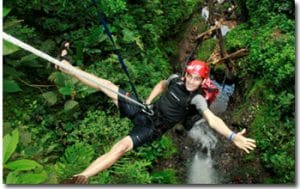 Once you’re ready to dial up the adrenaline, the Arenal activity options can get more daring! On a thrilling day of canyoning just outside La Fortuna, you’ll be scrambling over boulders, jumping into refreshing pools, and rappelling down a series of waterfalls. This is a half-day excursion of moderate difficulty that always proves to be an absolute crowd pleaser!
Want something even more extreme? Ask us about our Extreme Canyoning Tour in Arenal!
Soak in geothermal pools
Soaking in hot springs is a crowd favorite and it’s certainly not something you’ll want to miss. The unique geology of the area has spawned a bevy of mineral-enriched thermal pools and many hotels and lodges have sprung up all around them. The marvelous thing is that you’re not forced to stay overnight if you don’t want to: the best and most famous hot springs, within hotel grounds, are open to daytime visitors. Just keep in mind that some hot spring hotels offer private pools for guests so that’s an enticement that’s hard to forego.
Here’s our list of the best hot spring hotels in Costa Rica – note that not all are in the Areal and La Fortuna areas. Given the country’s many volcanoes, thermal springs abound!
La Fortuna Waterfall: What to Know Before Going
The waterfall gets a mention earlier in this guide but it deserves considerably more detail because visitors consistently underestimate what the experience actually involves and arrive underprepared.
La Fortuna Waterfall plunges approximately 70 meters (230 feet) into a deep natural pool of crystal-clear water. It sits on the southeastern edge of Arenal Volcano National Park at the base of Cerro Chato. The full round trip via the hiking trail covers approximately 5.5 km (3.4 miles).
Admission to La Fortuna Waterfall is separate from the national park entrance fee and costs approximately USD $18 to $20 per adult. This fee is reinvested directly into local conservation. Costa Rica Rios’ commitment to responsible travel aligns with these conservation principles; visitors can learn more about the approach on the Costa Rica sustainable tourism page.
Getting to the base of the falls requires descending approximately 500 stairs, which are steep and can be extremely slippery when wet. The climb back up is genuinely demanding, particularly in the afternoon heat. Closed-toe shoes with a solid grip are non-negotiable. Sandals and flip-flops should be left at the accommodation.
Swimming is permitted in the calm areas along the edges of the natural pool. The current directly beneath the cascade is extremely powerful and dangerous, and swimming near the base of the falls is strictly prohibited.
A viewing platform near the entrance provides an overhead perspective of the waterfall without requiring the full stair descent, making it a reasonable option for visitors who prefer not to manage the climb.
Lake Arenal: More Than Just a Backdrop
Lake Arenal is the largest lake in Costa Rica, covering approximately 85 square kilometers, and it sits just on the other side of the volcano from La Fortuna. Most visitors admire it from a distance, but the lake itself offers a full afternoon or more of excellent activity.
Kayaking and Stand-Up Paddleboarding: Rental operators along the lakeshore make independent access to the water easy. Paddling across the lake with the volcano rising behind is one of the quieter, more unexpectedly spectacular experiences the region offers.
Boat Tours: Guided tours on Lake Arenal combine time on the water with a walk along the Peninsula Trail sector, delivering views of the volcano from the lake surface that no land-based trail can replicate.
Fishing: Lake Arenal supports healthy populations of freshwater species including rainbow bass (guapote), machaca, and blue tilapia. Fishing charters operate from several points along the shore.
Photography: The western shore of the lake, particularly in the late afternoon, frames the volcano in extraordinary light. Travelers staying multiple days who are chasing a clear summit shot should plan at least one evening at the lakeside, where sunset views over the water are among the finest in the entire country.
Enjoy a day trip to the Tenorio Volcano National Park
The Tenorio and its iridescent Celeste River are about an hour’s drive north of La Fortuna. The river is famous for its incredible color and its gorgeous pool can be accessed via a relatively easy half-hour hike that culminates above an incredible staircase, which leads you down to the glowing emerald pools.
The Rio Celeste National Park is stunning and offers and offers a variety of trails and you could easily spend an entire day exploring its magical nature and wildlife. This is one of the best day trips you can take from La Fortuna and the river one of Costa Rica’s unique highlights.
Tackle an unforgettable river rafting excursion
Whitewater rafting is one of the most coveted outdoor adventures offered in Costa Rica. In and around Arenal, there are options for family-friendly Class II and III rapids (along the Balsa River, closest to La Fortuna) and more challenging Class III and IV rapids on the Sarapiqui River, only an hour’s drive away. The Balsa run is amazing and is relaxing enough to soak up your surroundings and even spot wildlife along the riverbanks. You can take it easy – especially if it’s your first time in a raft – and just enjoy the relaxing yet still a thrilling experience.
Sarapiqui, on the other hand, taps into the world-class rafting experiences for which Costa Rica is renowned. This river serves up 10 miles of twisting gorge runs and over 40 continuous rapids. This is the ultimate thrill-seeking Arenal experience for true adrenalin junkies.
Want to know what else you can do in Arenal? Here is our full list of 15 Amazing Things to Do in Arenal.
Unique Experiences Worth Adding to the Itinerary
Arenal’s appeal stretches well beyond the obvious adventure checklist. The following experiences add genuine cultural and sensory depth to any visit.
Cacao Farm Tours and Chocolate Making: Several farms in the La Fortuna area welcome visitors for hands-on cacao experiences. These tours walk through the full growing and harvesting process before guiding participants through making chocolate from raw cacao.
It is an engaging cultural activity appropriate for all ages and one that connects visitors directly to Costa Rica’s agricultural heritage.
Volcanic Mud Treatments: Several spas and wellness centers in and around La Fortuna offer treatments using volcanic mud sourced from the region’s geothermal activity. A volcanic mud facial or full-body wrap followed by a soak in mineral-rich thermal pools is a remarkably effective recovery experience after a day of physical activity.
Travelers who want to build their entire stay around the hot spring and wellness circuit can explore the full list of hot springs in Costa Rica, including options beyond the Arenal region.
Most resorts along the hot spring corridor offer some form of this treatment, either as a standalone option or as part of a broader spa package.
Costa Rican Cooking Classes: Local operators in the La Fortuna area offer hands-on classes focused on traditional Costa Rican cuisine, including gallo pinto, fresh ceviche, and plantain dishes prepared using locally sourced ingredients. A cooking class makes for an excellent evening activity or a change of pace on a slower day.
Safari Float on the Peñas Blancas River: For visitors who want wildlife immersion without the physical intensity of a jungle hike, a gentle river float along the Peñas Blancas River is a standout alternative.
Located approximately 45 minutes from La Fortuna, this float suits all ages and fitness levels. Caimans, kingfishers, basilisk lizards, and various heron species are among the wildlife commonly spotted along the forested riverbanks.
Caño Negro National Wildlife Refuge Day Trip: For birding enthusiasts and wildlife photographers willing to travel a little further, Caño Negro is one of the most biodiverse wetland ecosystems in Central America.
Located approximately two hours from La Fortuna, the refuge hosts Jabiru storks, roseate spoonbills, anhingas, and an extraordinary density of aquatic birds. Visiting during the green season, when rivers swell and animals concentrate at the waterways, offers particularly spectacular wildlife encounters.
How Much Does It Cost to Visit Arenal?
Having a realistic budget in mind before arriving avoids unpleasant surprises and helps make the most of the time on the ground.
National Park Entry: USD $15 per adult plus tax, USD $5 per child plus tax. Credit card only.
- La Fortuna Waterfall Admission: Approximately USD $18 to $20 per adult, charged separately from the national park fee.
- Guided Hike Tours: Typically USD $50 to $150 per person depending on activity type and duration.
- Hot Springs Day Pass: Free natural hot spring access exists at spots like the Río Chollín area near Tabacón. Resort-based hot spring day passes range from approximately USD $30 at mid-range properties to USD $50 to $80 at premium facilities such as Tabacón Grand Spa Thermal Resort.
- Zip-line Tours: Typically USD $50 to $80 per person.
- Whitewater Rafting: Typically USD $60 to $100 per person depending on river and class level.
- Horseback Riding Tours: Typically USD $50 to $80 per person for two to six-hour tours.
- Taxi from La Fortuna to the National Park: Approximately USD $10 each way.
- Budget Tip: Eating at local Costa Rican eateries called sodas is one of the most effective ways to manage food costs. A full traditional meal at a soda costs as little as USD $6 to $10 per person. Several options sit around La Fortuna’s central park area.
- Seasonal Tip: Accommodation and tour pricing drops noticeably during the green season (May through November). Travelers who prioritize value over guaranteed sunshine will find significantly better rates during these months compared to the peak dry season window of December through April.
Frequently Asked Questions About Visiting Arenal Volcano
Is the Arenal Volcano still active, and is it safe to visit?
Arenal entered a dormant phase in October 2010 after an eruption cycle that began with the catastrophic 1968 event. Scientists classify it as still geologically alive but currently resting. Visiting is completely safe within all designated areas. Rangers monitor the volcano continuously, and trails are closed immediately at any sign of increased activity.
Can visitors hike to the summit of Arenal Volcano?
No. Ascending the summit is not permitted for safety reasons. The national park guides visitors to viewpoints and lava fields around the volcano’s base rather than toward the crater.
Do visitors need a guide, or can the park be explored independently?
The park is fully accessible on a self-guided basis, and no guide is required for entry. However, a knowledgeable naturalist guide dramatically improves wildlife spotting and adds valuable geological context to the experience. No guides are available for hire at the ranger station itself, so arranging one through a La Fortuna tour operator in advance is the recommended approach.
Is a 4×4 vehicle required?
A 4×4 is not required to reach the main visitor center parking lot of the Volcano Sector or the Peninsula Sector entrance. A 4×4 is required only to drive the Vehicle Trail within the Volcano Sector. Visitors without one can simply walk the same trail.
Can visitors see lava or eruptions?
Not currently. Since 2010, the volcano has not produced significant lava flows or explosive activity. Steam and gas emissions are occasionally visible from the crater on clear days. Some visitors report faint glowing from residual heat on the western flank at night, though this is far from guaranteed.
What is the best time of day to see the volcano clearly?
Early morning, generally before 9:00 AM, offers the best chance of an unobstructed summit view before cloud cover builds. Staying at an accommodation with a direct volcano view and waking at sunrise is the single most reliable strategy for clear sightlines.
Are drones allowed inside the park?
No. Drones are prohibited from being brought into the national park.
Is the park accessible for visitors with mobility needs?
The Peninsula Sector is the most accessible area of the park, with flat and well-maintained paths. A dedicated accessibility path and viewing platform are currently under construction at the end of the Peninsula Trail, which will significantly improve inclusive access once complete.
How many days should be dedicated to the Arenal region?
Most visitors spend two to three days, which comfortably covers the national park, La Fortuna Waterfall, hot springs, and one or two adventure activities. Visitors who want to include Tenorio Volcano, Río Celeste, a rafting excursion on the Sarapiquí, Lake Arenal, and day trips to Caño Negro will find a full week easily justified.
Experience Arenal Volcano with Costa Rica Rios!
So much to do and don’t know where to start? We’re here to help!
At Costa Rica Rios, we plan award-winning adventure tours for families, couples, and solo travelers. We offer group tours and tailor-made adventures and can include as many of the above-mentioned activities as you can fit into your itinerary. We can plan everything from A to Z, including transfers, national park guides for hikes and wildlife trips, and overnight accommodation according to your wishes and budget.
We also offer Arenal Activity Options if you’re looking to spend a day out with us on a mind-blowing adventure.
Plan Your Arenal Adventure Today!
 Wind back the history-clock a few decades and you’d see a bunch of curious scientists studying unique flora and fauna in the remotest nooks of Costa Rica’s virgin
 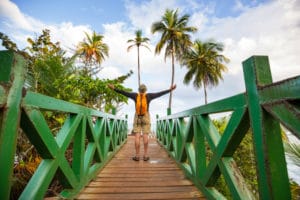 Hanging bridges get you up close and personal with what is, essentially, impenetrable wilderness. When you leave the walking trails behind (or rather, below), you enter a whole different kind of natural kingdom, one that you wouldn’t otherwise ever get to see. Hanging bridges often stretch across deep valleys and gorges, places you’d need hours of hard
  Every single one of Costa Rica’s best hanging bridges offers something unique and, for many, the choice simply comes down to convenience. Where you choose to base yourself, or travel to, will likely have a big impact on your ultimate choice. Having said that, some people specifically seek the longest trail or the one with the most bridges or, in the case of two options below, the one with the most ‘extras’ like zip-line, hummingbird garden and so forth.
 Head west to Nicoya and you can take a walking trail to Montezuma’s beautiful waterfalls on a short but rewarding excursion. The three-tiered falls are just lovely, immersed in wilderness whilst also offering a great chance for a swim. This is a local hang-out and totally off the commercialized-trail. There are two ways to reach the falls: one along a riverside trail and the other (the one you’ll want) is on a canopy trail that’s easily accessible. The Sun Trails canopy tour isn’t just a super easy way to reach the top falls (so you don’t need to tackle the steep climb up from the riverside trail) but it also guides you over a couple of outstanding hanging bridges. A thrilling zip-line tour is also available if you want to add an adrenaline-rush to your visit. This no-bling option is perfect for nature-lovers who prefer a more rustic hanging bridge experience and, obviously, those who are planning an adventure vacation over on the Nicoya Peninsula.