
Locating the Best Horseback Riding Locations in Costa Rica

Horseback riding in Costa Rica opens trails no road can reach. Forests, volcanoes, rivers, remote beaches. None of it is visible from a car window. On horseback, the country slows down. Wildlife shows up. Guides talk. The whole trip feels different.
This guide covers the best regions, what to expect on the trail, how to pick a good operator, and a vetted list of tour providers that have been running rides across the country for years. Whether this is the first time on a horse or the fiftieth, there is a ride here that fits.
Costa Rica and Horses: A Culture That Goes Back Centuries
Costa Rica and horses go back further than most people know. When Spanish settlers arrived in the 1500s, horses came with them. Cattle ranching spread across Guanacaste. Horses were how farmers moved herds, checked land, and got from one town to the next. There were no paved roads. There was no other way.
The “sabanero” is the Costa Rican cowboy. Think of the American ranch hand or the Argentine gaucho. Same work ethic. Same relationship with the land. Guanacaste was, and still is, their home province. Sabaneros ride with a posture that is hard to fake. It takes years on this terrain to develop.
Horses are still a point of pride here. Festivals across the country feature “topes,” which are horse parades where riders dress up, groom their horses to a high shine, and ride through town. San Jose hosts one of the biggest topes in December. Guanacaste holds regional events throughout the year. Watching a tope is one of the few things in Costa Rica that feels unchanged by tourism.
For visitors, all of this matters. Booking a horseback ride is not just choosing a fun thing to do. It connects a trip to something that runs through the country’s identity. Guides who grew up in the saddle share that history along the trail. That is context no zip line can provide.
Why Horseback Riding Beats Most Other Tours Here
Other tours in Costa Rica move fast. Zip lines are over in seconds. ATV tours put a layer of noise between the rider and the forest. White-water rafting demands full attention for stretches at a time. Horseback riding does none of those things.
Horses go where vehicles cannot. Forest paths too narrow for any quad. Mountain trails where the footing requires four legs, not two wheels. Remote beaches with no road access at all. The animal covers the terrain while the rider looks around.
The pace is the point. Howler monkeys are loud. They’ll hear a horse before they hear a van. Toucans sit in the canopy at eye level from the saddle. Guides on horseback know where wildlife shows up and when to stop. That knowledge is not in any brochure.
Beginners are welcome on most tours. Tour operators match horses to rider skill. Gentle, steady horses for first-timers. More responsive horses for people who ride regularly. Age is rarely a barrier. Families with young children book these tours. So do older couples on anniversary trips. The tours scale.
The Best Horseback Riding Companies in Costa Rica
Not every operator runs the same kind of tour. These five have been vetted over years of bookings, guest feedback, and on-the-ground visits. Each one serves a different part of the country and a different style of rider.
Discovery Horseback Tours – Puntarenas Province
 Leaders in their field, this multi-award winning company has always placed their horse’s welfare before profits since their inception, and their commitment to ethical and professional service made them the poster-kids of horse riding in Costa Rica. What we love about these guys is that they epitomize all that is utterly unique and delightful about this country. The company was started by a couple of foreigners – who arrived here with backpacks and never left – and have built one of the most admired business in the country, employing some of the most experienced and committed locals.
Their stunning 1500-acre ranch sits just outside Jaco and can also be easily reached from Los Suenos or Playa Hermosa. Daily tours include a fabulous half-day Back Country expedition which will see you ride through local villages, butterfly farm, rivers and forests (suitable for beginners) as well as a more challenging Road-less-travelled Expedition where you, and your adventurous steed, will be put through your paces on a fantastic run through some of the most remote parts of the property.
Centaura Farm – Alajuela Province
 CNN famously rated Centaura as providing one of the world’ very best horse riding experiences and, with that kind of accolade, you know you’ll be in for an unforgettable Costa Rican adventure. Offering a plethora of unique experiences, from riding on deserted beaches, through pristine cloud forests and mountain tops, the guys and gals at Centaura have an adventure, and horse, to suit every desire imaginable. With Centaura you’ll have the best of horse riding and Costa Rica, right at the tip of your hooves. You’ll find Centaura farm right nearby Arenal Volcano.
Horse Trek Monteverde – Puntarenas Province
Monteverde’s premier agency can tailor make trips to suit your needs, from half day introduction classes to 8-day expeditions to some of the most stunning and remote wilderness of this region. On this week long trek you are guaranteed to get a taste of every wonder which makes this country so special: nature, hospitality and adventure. Young, old, experienced or not, this ranch is ideal for anyone and everyone. Rest assured that you’ll be riding with experienced and professional leaders who could ride through this region blindfolded. Your comfort, security and satisfaction are unsurpassed priorities here.
Traveling to Guanacaste? Then let Casagua show you the way, along with their extended families of born-and-bred local steeds. Kay and Esteban have developed a legion of cult followers through the years, and are particularly renowned for their friendliness and attention to detail. First time on a horse and a little anxious? Head here! Casagua offer personalised and small group tours, so if you’re at all worried about your ability –or lack thereof – these guys will surely put your mind at ease. They have a gentle-natured horse to match your fears. Pick and match your likes, and plan the kind of Costa Rican horse riding experience you’ve always dreamed about. Beaches, forests, jungle and mountains, there’s nowhere you can’t go…when you’re on the back of a horse!
Finca Caballo Loco – San Jose Province
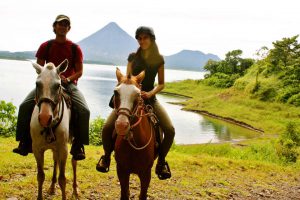 This wonderful horse riding ranch is in the Central Valley just a wee little drive away from the capital, San Jose. Wonderfully conveniently and superbly rated, Finca Caballo Loco offers a wealth of tours through astonishing wilderness; through rivers, along vertiginous canyons, into secondary forests and splendid jungles. If you’re only in Costa Rica for a few days, and wish to pack it all in, then this central ranch is just the ticket to get you in, and on the back of a horse, in no time at all.
The Best Regions for Horseback Riding in Costa Rica
The region decides everything here. Terrain, scenery, what wildlife to expect, and the type of trail all change depending on where in the country the ride takes place. These are the seven regions that offer the most variety and the best conditions.
Arenal and La Fortuna
Arenal is the most dramatic backdrop in the country for a horseback ride. The volcano sits at 1,633 meters and dominates the skyline. On a clear morning, it is visible from almost every trail in the area. Guides in La Fortuna take riders through cattle farms and secondary forest on routes that gain altitude slowly. Some tours end with a hike to the La Fortuna Waterfall, a 70-meter drop that requires leaving the horses behind for the final section.
The Arenal Conservation Area covers more than 120,000 acres. Trails inside it cross rivers, wind through tree fern groves, and open up to views of Lake Arenal. This is the lake created by the Arenal Dam in 1979. On still mornings, the water reflects the volcano perfectly.
Tours here typically run two to four hours. Some operators combine the ride with hanging bridge walks or hot spring visits in the afternoon.
Monteverde Cloud Forest
Cloud forest riding is not like any other terrain in Costa Rica. Monteverde sits at about 1,440 meters. The air is cooler. The trail surface is often wet. Mist moves through the trees in the morning and burns off by mid-afternoon. Riders pass through pastures that border the cloud forest reserve, with views across to the Gulf of Nicoya on clear days.
This region gets heavy rain from May through November. A waterproof layer is not optional here. Guides know which trails drain well and which get slick. They route around problem sections on wet days. Take their advice seriously.
The wildlife mix in Monteverde is different from lower elevations. Resplendent quetzals live in this forest. So do tapirs, though sightings are rare. Howler monkeys are regular. The birdwatching from horseback in this region is genuinely hard to beat anywhere in Central America.
Guanacaste
Guanacaste province borders Nicaragua to the north and the Pacific Ocean to the west. Dry tropical forest covers much of the inland area. The coast has some of the longest beach stretches in the country, many accessible only on horseback or on foot.
Towns like Tamarindo, Samara, and Nosara all have operators who run beach and jungle combinations. The typical route goes from a ranch into a secondary forest, crosses one or two small rivers, and drops onto the beach. The beach section is where riders can canter, depending on skill level and horse temperament.
Guanacaste is also the driest part of Costa Rica. The wet season runs from May to November, but rainfall is less than in Monteverde or the Caribbean. Rides here are possible year-round with good conditions through most months.
Manuel Antonio
Rainforest trails run close to the coast around Manuel Antonio. The national park sits on a small peninsula on the Central Pacific. Horseback riding tours do not enter the park itself, but the surrounding hills and back roads offer a different kind of access to the same ecosystem.
Most Manuel Antonio rides go through farms and secondary forest, with the option to reach a waterfall or a private beach. The Nauyaca Waterfalls are a popular endpoint. The lower fall drops about 35 meters into a natural pool. Getting there on horseback takes roughly two hours each way. It is a long day, but most riders say it is worth it.
Wildlife spotting in this area includes white-faced capuchin monkeys, sloths, and scarlet macaws. The macaw population around Manuel Antonio has recovered significantly over the past 20 years following habitat protection efforts.
Nosara and the Nicoya Peninsula
Beach riding at sunset sounds like a cliché. In Nosara, it earns the description. Playa Guiones stretches over a mile of open beach with consistent surf. Playa Pelada sits just north and is calmer, better for riders who want to move at a walk along the water.
Tours in this area typically run two hours. Morning rides catch the wildlife before the day heats up. Afternoon rides end near sunset. Both are worth considering depending on the rest of the day’s plan. Cost is about $80 per person for a standard two-hour tour.
The Nicoya Peninsula has the slowest pace of any region on this list. That is not a criticism. It fits the style of riding. Guides here often stop to explain the local mangroves or point out the Guanacaste tree, which is Costa Rica’s national tree and grows large enough to shade a dozen horses at once.
Caribbean Coast
The Caribbean side feels different from everywhere else in Costa Rica. The culture is Afro-Caribbean. The food is different. The music is different. The coast near Puerto Viejo and the Gandoca-Manzanillo Wildlife Refuge offers riding through a landscape that does not look like the rest of the country.
Jungle trails here are thick. Shade is constant. The beach sections are darker sand, backed by dense vegetation right to the waterline. Howler monkeys are everywhere. Toucans and parrots are regular sightings.
This region is wet most of the year. Bring bug spray. The humidity is higher than the Pacific coast. Trails are often muddy. Good guides know this and route accordingly. The Caribbean is not the most popular region for horseback tours, but it offers the most distinct sense of place.
Central Valley
San Jose is closer than most people think to quality riding. The Central Valley sits at about 1,200 meters elevation. Temperatures are mild year-round, rarely too hot or too cold. The area around Turrialba, the Poas Volcano slopes, and the San Gerardo de Dota valley all offer mountain riding on trails that pass through coffee farms, dairy farms, and secondary forest.
This is the region with the highest concentration of multi-day riding options in the country. Operators who run three, five, or eight-day treks almost all start or pass through the Central Valley. For people with more than a half-day to spend on horseback, this is where to base.
What to Expect on a Costa Rica Horseback Riding Tour
Most rides run two to four hours. Some operators offer half-day tours that include transport to and from the hotel. Full-day options are less common but available in certain regions, especially Arenal and the Central Valley.
Terrain changes depending on the region. Beach rides move at a walk or slow trot on firm sand. Mountain rides involve uphill sections where the horse sets the pace. Forest trails are often narrow. Riders go single-file behind the guide.
Group sizes matter. Larger commercial tours run eight to twelve riders. Smaller operators cap groups at four to six. Smaller groups get more guide time and cover more ground. Quality operators always have at least two guides, one at the front and one at the rear, for a group of any size.
Wildlife sightings on horseback are common. Horses move quietly. They also signal when wildlife is nearby by slowing or turning their ears. Guides know what to look for. Howler monkeys, coatis, toucans, parrots, and sloths are regular sightings depending on the region.
Helmets are provided by all quality operators. Wearing one is not optional on a reputable tour. If an operator does not offer a helmet, that is a signal to book elsewhere.
How to Choose a Good Operator
Horse welfare separates good operators from bad ones. Check the horses on arrival. Well-kept animals have healthy weight, clean hooves, and calm behavior. Thin horses, visible sores, or anxious behavior near people are warning signs. Leave if any of these are present.
Ask how many riders will be in the group. More than eight is a large group for a trail ride. Ask how many guides will be present. One guide for eight riders is the minimum. Two guides for six is better.
Ask about insurance. Tour operators who carry liability coverage and include it in the booking are running a professional operation. Those who do not are cutting a corner that matters if something goes wrong.
Check Tripadvisor and Google reviews, but read them carefully. Look for reviews that mention guide knowledge, horse behavior, and safety gear. Reviews that only say “amazing views” and “great time” are less useful. Reviews that describe how guides handled a nervous rider or how a horse reacted to uneven terrain say a lot more.
For any multi-day trek, ask who the overnight hosts are, what the horses eat at camp, and how tired horses are managed. The answers reveal whether the operator has thought through the whole experience or just the first morning.
What to Wear for Horseback Riding in Costa Rica
Gear for horseback riding in Costa Rica keeps it simple. Long pants are the single most important item. Jeans or hiking trousers work well. Shorts create friction against the saddle and cause discomfort on rides longer than one hour. Thin fabric is fine. It does not need to be heavy.
Closed-toe shoes are required. Sandals and flip-flops are not allowed on any quality tour. Shoes with a small heel are ideal as they prevent the foot from sliding through the stirrup. Standard sneakers work fine.
Bring a hat with a brim. Sun exposure from horseback is higher than on foot because there is no movement to create a breeze. A brim hat covers the face and neck. Add sunscreen to any exposed skin before the ride, not during it.
Bug spray is useful for rides in forest and jungle areas. Apply it before getting near the horses. Strong chemical sprays can irritate horses’ skin and eyes. Spray at least 15 minutes before arrival at the stable.
A light waterproof layer is worth packing for Monteverde or any Caribbean-side ride. Weather changes fast at altitude. A thin jacket that folds into a pocket adds no weight and covers the situation when clouds arrive.
How Much Does Horseback Riding Cost in Costa Rica?
Tours run from about $50 to $150 per person. The range reflects duration, region, and what is included. Here is how the breakdown tends to work.
Short beach rides of one to two hours typically cost $50 to $80 per person. These are common in Guanacaste and Nosara. Transport is often not included. The Nosara standard rate is about $80 for two hours.
Half-day tours that last three to four hours, include transport from the hotel and a guide, run $80 to $120 per person. This is the most common tour format. Most operators in Arenal, Manuel Antonio, and Monteverde fall in this range.
Full-day tours that include meals, transport, and a waterfall destination run $120 to $150 per person. The Nauyaca Waterfall ride near Manuel Antonio and the Discovery Horseback Tours Back Country full-day option fall in this category.
Multi-day treks cost significantly more and vary widely. Three-day trips start around $600 per person. Eight-day expeditions run $2,000 to $3,000 depending on the operator and the accommodation style.
Booking directly with operators is often cheaper than booking through a hotel concierge or third-party platform. The quality is the same. The margin is not.
Frequently Asked Questions
Is horseback riding in Costa Rica worth it?
Yes. It covers terrain no other tour format reaches. Beaches with no road access, forest trails too narrow for any vehicle, mountain paths that require the footing of a horse. For people who want to see a part of the country most visitors miss, the answer is straightforward.
What is the best area in Costa Rica for horseback riding?
It depends on what the ride should feel like. Arenal offers volcanic scenery and forest trails. Monteverde gives cloud forest and cooler temperatures. Guanacaste has beach-to-jungle routes and cowboy culture. Manuel Antonio combines rainforest with waterfall access. Each one is distinct. Pick based on where the rest of the trip is based.
Is horseback riding safe for beginners in Costa Rica?
Yes. Reputable operators match horses to rider skill. Beginners get calm, well-trained horses that know the trail. Guides ride at the front and rear. Helmets are provided. The terrain on beginner routes is chosen to be manageable at a walk. First-time riders leave most tours without incident.
What is the best time of year to go horseback riding in Costa Rica?
The dry season runs from December through April and is the most popular time. Trails are dry, weather is predictable, and visibility is good. That said, the wet season from May to November brings lush green scenery and fewer crowds. Guanacaste is the driest region in the wet season and rides there continue year-round without major disruption.
What breed of horse is used on Costa Rica tours?
Most operators use Criollo horses or the Paso Costarricense. The Paso Costarricense is a gaited horse descended from Andalusian and Peruvian Paso bloodlines. The gait is smooth and four-beat. Riders feel very little of the up-and-down motion that makes trotting uncomfortable. For beginners, this makes a long ride feel easy.
Ready to book a horseback riding tour in Costa Rica? Costa Rica Rios has been building custom adventure trips since 1995. National Geographic Adventure named us among the best adventure travel companies in the world. Lonely Planet recommends our tours. Get in touch to build a trip around the region and ride style that fits best.