
Ultimate Whale-Watching Guide to Costa Rica

Of all the adventures Costa Rica offers, none hit quite like watching a humpback breach. These giants of the sea, remarkably acrobatic for their size, are some of the most jaw-dropping mammals alive.
They can live up to 100 years. They measure up to 53 feet in length. They consume up to 1.5 tons of krill every single day.
Watching them on migration is a bucket-list moment like no other. Many people who witness a whale sighting describe it as life-changing. Hard to disagree.
Planning a trip to Costa Rica for whale watching? This guide covers the why, the when, the where, and what to expect from the water. Read it before booking anything.
Why Costa Rica is Best
 There are roughly 25 different species of whales and dolphins who migrate off the Pacific Coast every year and the humpback whale, in particular, is found here almost 8 months of the year. This makes Costa Rica home of the longest-running whale watching season in the world. Plus, you get to experience all its tropical gorgeousness, jungles and beaches, none of which is found in Antarctica. Win-win!
What Makes Humpbacks So Revered
The humpback is considered the ‘holy-grail’ of wildlife viewing, as even though many species of whales are deep-sea dwellers and difficult to spot on the sea’s surface, the humpback is shy of coming forward. Or, in this case, on putting on a formidable spectacle for amazed spectators. Moreover, they are curious by nature and will often close in on a boat to have a better look-see. Their propensity for gymnastic, and innate extroverted nature, make them the most delightfully entertaining whales to observe.
What Makes Humpbacks So Revered
Most whale species are deep-water dwellers. Spotting them from a boat is hit or miss at best. The humpback is different. It stays near the surface. It performs. Breaching, tail-slapping, spy-hopping; all of it happens in plain sight.
They are also curious by nature. Humpbacks will close in on a boat to investigate. That closeness is what makes them the holy grail of wildlife viewing. Size and personality in one package. No other whale delivers both.
The Two Migration Seasons Explained
Costa Rica is one of very few places on earth where two separate humpback populations converge. Both groups use the warm Pacific waters to breed, give birth, and nurse their young. But they come from opposite ends of the planet.
Northern hemisphere whales feed off the coasts of Alaska and California during summer. When temperatures drop in late November, they head south. These whales arrive in Costa Rica from late December and stay through mid-March. February is the peak month for this group.
Southern hemisphere whales spend the South American summer feeding near Antarctica. When winter hits the southern hemisphere in June, they begin the longest migration recorded for any mammal: up to 5,160 miles. They arrive in Costa Rica from late July and stay through mid-October. August and September are the peak months.
The gap between seasons (April through June) is the one window when humpbacks are largely absent. Plan around it.
This dual-season structure is why Costa Rica holds a distinction no other country can claim: eight months of possible whale sightings, year-round.
Best Time to Visit Month by Month
Not every month is equal. Here is what each period actually delivers:
- December: Northern hemisphere whales start arriving. Numbers are low early in the month. By late December, sightings pick up. Good time if combined with other Costa Rica activities.
- January: Northern whales are active. Sighting frequency increases. Uvita and Drake Bay both produce reliable encounters.
- February: Peak month for northern hemisphere humpbacks. High activity, mother and calf pairs visible, good chances of close encounters. A strong choice for dry-season visitors.
- March: Northern whales start thinning out after mid-March. Early March is still good. Late March is hit or miss.
- April through June: Transition and gap period. Humpbacks are largely absent. Dolphin and pilot whale sightings still happen, but dedicated whale watching tours are less reliable.
- July: Southern hemisphere whales begin arriving. Numbers build through the month. Sightings are possible but not yet consistent.
- August: Peak begins. Southern whales are fully present and highly active. The most reliable month for sightings on the Pacific coast. Mother and calf pairs are common.
- September: Equal to August in whale activity. Near-daily sightings reported from Uvita and Drake Bay. Best for anyone who wants the highest probability of a close encounter.
- October: Southern whales start departing mid-month. Early October is still very good. Activity drops sharply after mid-month.
- November: Southern whales mostly gone. A quiet stretch before northern arrivals in December.
For near-daily sightings and highest encounter rates, August and September are the answer. For good sightings in dry-season conditions, January and February are the call.
Best Places to Visit
Humpbacks can be spotted along most of the Pacific coast at certain times of year. But some spots deliver far better than others.
Uvita and Marino Ballena National Park
Uvita is the whale watching capital of Costa Rica. The town sits inside Marino Ballena National Park, a protected marine area created specifically to conserve the waters where humpbacks breed and raise young. Boats depart directly from the park beaches.
Both northern and southern season whales are seen here. That makes Uvita the only spot that consistently produces sightings across both seasons. For anyone who is serious about whale watching, Uvita is the right base.
Book tours at least 2 to 3 days in advance in August and September. They fill.
Osa Peninsula and Drake Bay
The Osa Peninsula ranks as the top location for humpback sightings. The warm waters off its coastline are where humpbacks spend the most time. Drake Bay is the main departure point for day trips into these waters. Caño Island is nearby and often included in full-day excursions, which also cover snorkeling and beach stops.
Beyond humpbacks, the Osa Peninsula waters hold pilot whales and several dolphin species regularly.
Golfo Dulce
The Golfo Dulce sits inside the Osa Peninsula and functions as a protected nursery for newborn calves. The calm water and low predator pressure make it ideal for mothers nursing young. Sightings here are up-close and unhurried. Fewer boats in the water means quieter encounters. This area is less visited than Uvita but delivers.
Manuel Antonio
Manuel Antonio is a good option for those already staying in the central Pacific zone. Humpbacks are seen here during August and September on catamaran tours. Sighting rates are not as high as in Uvita or Drake Bay. The one-hour drive south to Uvita is worth it for a dedicated whale watching day.
Guanacaste and Gulf of Papagayo
Humpbacks appear in the Gulf of Papagayo from July through September. Sightings happen on snorkeling and sailing tours out of Tamarindo, Flamingo, and Playas del Coco. No dedicated whale watching tours operate from this area, but encounters are common enough on other boat excursions during the peak months. February sightings have also been reported near Santa Rosa National Park.
Nicoya Peninsula
The waters off the Nicoya Peninsula see seasonal humpback traffic. The Tortuga Island day cruise is a known option for a whale encounter during August and September. Not the highest probability location, but worth knowing for visitors based in this region.
What Whale Species Can You See
Humpbacks get all the attention. They should. But Costa Rican waters hold other species too.
Bryde’s whales are seen periodically in Pacific waters. They are mid-sized baleen whales and surface more often than most deep-water species.
Pilot whales appear near the Osa Peninsula. They are technically the second-largest oceanic dolphin, though most people encounter them on whale watching tours.
Sperm whales are spotted occasionally near Drake Bay and the Gandoca-Manzanillo refuge. They are visible from the surface when present.
Orcas have been recorded in Costa Rican waters but are not common. Treating a sighting as a bonus is the right expectation.
Dolphins are a different story. Several species are present year-round:
- Bottlenose dolphins along both coasts
- Spotted dolphins in open Pacific waters
- Spinner dolphins (December through March on the Pacific)
- Rough-toothed dolphins in offshore zones
- Common dolphins, known for acrobatic surface feeding
On most whale watching tours, dolphin pods will approach the boat. Pods of 50 or more are not unusual during peak season. Turtles and seabirds, including pelicans diving hard into the water, are part of the picture too.
What to Expect on a Tour
Most whale watching tours run 3 to 4 hours. Half-day and full-day formats exist depending on the area.
Boats range from small outboard skiffs to mid-sized inboard vessels. Small boats offer more mobility and tend to reach whales faster when a sighting is radioed in. Larger boats are steadier, which matters if anyone in the group is prone to motion sickness.
Boat captains work in networks. When a whale is spotted by any boat in the area, the location is radioed out and other captains move toward it. This coordination is what makes encounter rates high rather than luck-based.
Group size matters for the experience. A boat of 12 to 14 passengers plus crew gives enough eyes to spot activity without overcrowding the deck. Very small private tours offer flexibility but cost more.
Tour prices run from about $50 per person for a basic half-day to $100 to $150 per person for guided full-day excursions, some of which include a snorkel stop at Caño Island or a beach stop inside Corcovado National Park.
What to look for in a tour operator:
- Transport included in the price
- A naturalist guide on board who speaks English
- Clear group size limits
- Respect for wildlife regulations (no swimming with whales or dolphins)
Booking through known local agencies rather than last-minute beach vendors is the right call. The better operators fill early.
Humpback Behavior on the Water
Seeing a humpback breach for the first time is disorienting. A 40-ton animal launching clear of the water is not something the brain processes quickly. Here is what to recognize when it happens.
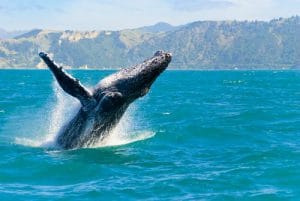
Breaching is the full or near-full launch out of the water, followed by a heavy crash back to the surface. The sound carries across the water. Scientists believe breaching may serve as communication. The sound volumes produced when that much mass hits water are significant.
Spy-hopping is when the whale rises vertically, head above water, to survey the surface. Self-explanatory once you see it. The whale is looking around.
Fin slapping involves a pectoral fin smacking the water surface repeatedly. Loud, hard to miss, and thought to be a communication or parasite-removal behavior.
Fluke flipping is the classic image: the tail raised above the surface before a deep dive. This is the signature move most people associate with humpbacks.
Blow is the water vapor column that shoots up when a humpback exhales at the surface. Visible from a distance. Captains often spot blows before any other behavior is visible.
Mother and calf pairs are a distinct experience on their own. Calves are playful and surface constantly. They are already 13 to 16 feet long and weigh close to a ton at birth. The play behavior, fins slapping, short breaches, surface rolls, is high-frequency and easy to photograph. The mother stays close.
Helpful Tips
- Many may think it worthwhile to book a private trip for themselves and their family only, but do keep in mind that the more eyes on board, the best your chance of seeing everything that’s out there. But too many people aboard can certainly make it a bit too rowdy, so aim to join a group of between 12 and 14 people, plus crew.
- Make sure you do some thorough research and book with a reputable tour operator which offers what you, specifically, need. Is transport included? What about food & drinks? Will you pay more for a side trip elsewhere in which you have no interest? Is there a naturalist guide on board? Do they speak English as well as Spanish? Is the agency ecologically minded? A whale-watching trip can be an expensive excursion (especially if traveling with a family) so make sure you know all there is to know about your intended tour agent.
- Book in advance if you can (at least by a couple of days) as great trips tend to book out fast.
- Consider packing motion sickness medication, especially if it will be your first time out on a boat. Excitement can make one forget to keep hydrated out at sea, so pack (and drink) plenty of water.
- That wide angle lens? Yep, you’ll need it. Many visitors make the mistake of only packing enormous zooms for good-quality distance shot, but fact is you are likely to need a wide angle lens as you will get much closer to these colossal creatures than you’d ever dreamed.
- Humpback whales are certainly not an uncommon sight in other areas of Costa Rica, like the northern Guanacaste coast, Nicoya Peninsula or off the shores of the Manuel Antonio National Park. However, chances of close and long-lasting encounters are not nearly as numerous there so if the main priority in your Costa Rica adventure trip is to spot whales, plenty of whales, then do go to the effort of reaching the best spots. This is a small, compact country with great roads and good infrastructure. Covering ground, even just in a single day, is both easy and rewarding.
- Whichever tour agency you choose to go with, do make sure they abide by the strict laws which govern whale and dolphin watching excursions. This includes no jumping off the boat to have a swim with either creature. Only scientific researchers are allowed to do that! A tour agency is not needed however if you choose to stay with Costa Rica Rios and order one of the several packages they offer.
- Don’t underestimate the amount of photos you will take so pack enough memory cards and charged batteries as you can carry!
Frequently Asked Questions
Is whale watching in Costa Rica guaranteed?
No sighting is ever guaranteed. Whales are wild and move freely. But encounter rates during peak season in Uvita, Drake Bay, and the Osa Peninsula are high. Captains use GPS and radio networks to coordinate sightings across boats. The chances during August and September are as good as any whale watching destination on earth.
What are the single best month to go?
August and September are the answers for highest encounter probability. Southern hemisphere humpbacks are fully present and very active. Near-daily sightings are reported from both Uvita and Drake Bay during this window.
Can you see whales in Costa Rica in December?
Yes. Northern hemisphere humpbacks begin arriving in late December. Early December is slower. By the last two weeks of the month, sighting frequency picks up. February is the stronger month for the northern season, but December and January deliver real encounters.
What is the difference between Pacific and Caribbean whale watching in Costa Rica?
The Pacific coast is where the industry runs. Both migration seasons pass through Pacific waters, and the infrastructure for tours is built out on this side. The Caribbean coast does see northern Atlantic humpbacks, but they do not approach Costa Rica closely and are far harder to spot. Dedicated Caribbean whale watching tours do not operate reliably. Stick to the Pacific.
How far in advance should tours be booked?
For peak months (August, September, February), book at least 3 to 5 days ahead. For all other months, 1 to 2 days is fine. Last-minute bookings in peak season usually find the good operators already full.
Can visitors swim with whales or dolphins?
No. Costa Rican law prohibits this for anyone other than scientific researchers. It is enforced. Reputable operators will not permit it. This regulation exists to protect the animals during their breeding season, when disturbance has real consequences for calves.
Costa Rica Rios has been operating adventure and wildlife tours in Costa Rica for over 30 years, recognized by National Geographic Adventure as one of the best adventure travel companies on earth. Whale watching excursions can be arranged as part of any custom itinerary, including Osa Peninsula packages and southern Pacific tours departing from Drake Bay and Uvita.