

The Most Famous National Landmarks in Costa Rica
The most famous national landmarks in Costa Rica take you on a whirlwind tour through the country’s long and illustrious history, showcasing the fact that Costa Rica is as rich in cultural and historical treasures as she is in nature-filled ones. From beautiful centuries-old cathedrals to opulent theatres, mysterious archaeological finds and incredible eco-tourism legacies, the following prominent landmarks beautifully complement the natural riches which have made this one of the world’s most revered travel destinations.
Include one, two or all on your next adventure vacation in Costa Rica, and make your journey a comprehensive, varied and immensely rewarding experience.













National Landmarks in Costa Rica
#1 Museo Nacional de Costa Rica, San Jose
 Housed within the protective walls of a late 18th-century fortress, the country’s largest and most important museum is as enthralling in content as it is in utter visual delight. Used during the civil war of 1948 (bullet holes are still visible) the Museo Nacional de Costa Rica offers a summarized glimpse into the history of the country from pre-Columbian times right up to the present day and hosts a wealth of beautiful historical artefacts, war memorabilia and more.
The fact that the Bellavista Fortress is an absolute splendor – and the addition of a stunning butterfly-filled garden together with English-language info-boards – make this an absolute must-visit for anyone traveling through the capital.
Location & Access
La Fortuna, Alajuela Province | 3 hours northwest of San Jose (92 miles/148 km) | 15 minutes from La Fortuna town center
What Makes It Special
Arenal Volcano’s near-perfect cone rising 5,437 feet dominates northern Costa Rica’s skyline. While currently dormant after regular eruptions from 1968 to 2010, the volcano remains one of the country’s most recognizable landmarks. The 29,850-acre national park protects old lava flows, rainforest trails, and diverse wildlife, including over 500 bird species.
Visiting Information
- Cost: $15 USD adults, $5 USD children (plus tax)
- Hours: Main sector 8am-4pm daily (last entry 2:30pm) | Peninsula sector 8am-5pm (last entry 4pm)
- Time Needed: 3-4 hours minimum for one sector, full day for both
- Tickets: Purchase at entrance (credit card only, no cash) | No advance reservation required
- Note: One-time entry ticket only; visiting both sectors requires seeing them same day or buying separate tickets
What to See & Do
Main Hiking Trails:
- Las Coladas Trail (2km): Follows 1992 lava flow with volcano viewpoints
- El Ceibo Trail (2.2km): Loops through secondary rainforest, easier terrain
- Los Tucanes Trail (3km): Bird watching hotspot, connects to Heliconias Trail
- Los Miradores Trail (1.3km): Multiple lookout points over Lake Arenal
Wildlife: Toucans, howler monkeys, coatis, sloths, tayras, white-faced capuchins. Early morning (7-9am) offers best sightings.
Nearby Attractions:
- La Fortuna Waterfall (separate $18 USD entrance, 500+ stairs down)
- Hot springs (multiple options from free Rio Chollin to luxury Tabacon $50-80)
- Lake Arenal (kayaking, fishing, paddleboarding)
Best Time to Visit
Dry season (December-April): Clearest volcano views, especially February-March. Arrive before 9am before clouds roll in.
Green season (May-November): Lush landscapes, fewer crowds, afternoon rain common.
Insider Tips
- There are no bathrooms inside trails; use facilities at the visitor center before hiking
- Bring layers; the temperature drops at higher elevations
- 4×4 is not required for main parking, but it is needed for Vehicle Trail
- Download offline maps; cell service spotty in parts of park
- Combine with hanging bridges at Mistico Park (15 minutes away)
Getting There
- Self-drive: Best option, well-maintained roads (no 4×4 required for main access)
- Public bus: San Jose to La Fortuna ($5-7 USD, 4-5 hours), then taxi to park ($8-12)
- Organized tours: Include transportation, guide, entrance fees ($80-150 per person)
#2 Museo de Oro pre-Columbino, San Jose
 Concentrating on the pre-Columbian era, this ‘museum of gold’ gifts a fascinating look into the complex and unique attributes of Costa Rica’s ancient indigenous cultures. Found right next door to the abovementioned Teatro Nacional, the Museum of pre-Columbian Gold showcases an interesting, comprehensive and quite glistening collection of ancient gold dating back to 500AD. From animal statuettes to amulets, jewelry and coins, the collections here are incredibly interesting especially if you’re party to ancient history.
Location & Access
Pacific Coast, Puntarenas Province | 7km south of Quepos | 3.5 hours from San Jose (110 miles)
What Makes It Special
Costa Rica’s smallest yet most visited national park packs pristine white-sand beaches, accessible rainforest trails, and remarkable wildlife density into just 1,983 acres. Three beaches inside park boundaries offer swimming and snorkeling, while trails wind through coastal rainforest where sloths, monkeys, and colorful birds are practically guaranteed sightings.
Visiting Information
- Cost: $18 USD adults, $5 USD children 2-12, free under 2
- Hours: 7am-4pm Tuesday-Sunday | Closed Mondays
- Time Needed: 4-6 hours minimum (most visitors stay full day)
- Daily Limit: 600 visitors maximum
- Tickets: MANDATORY advance online booking through SINAC website | Book 3-4 weeks ahead, December-April, 1-2 weeks ahead other months | NO same-day tickets at entrance
- Passport Required: Bring physical passport or digital copy for entry
What to See & Do
The Three Beaches:
- Espadilla Sur: First beach, calm waters, perfect for swimming
- Manuel Antonio Beach: Most popular, white sand, tide pools at south end
- Puerto Escondido: Smallest, most secluded, accessed via Cathedral Point trail
Main Trails:
- Sloth Trail (1.4km): Easiest walk, high sloth sighting probability
- Cathedral Point Trail (1.3km): Connects beaches, scenic ocean views
- Perezoso Trail (700m loop): Best for three-toed sloths and white-faced capuchins
Wildlife Highlights:
- Three-toed and two-toed sloths (visible 80% of time with patience)
- Four monkey species: white-faced capuchin, howler, spider, squirrel
- 350+ bird species including scarlet macaws, toucans, tanagers
- Iguanas, basilisk lizards, coatis, agoutis
Snorkeling: Bring gear for Manuel Antonio Beach—see tropical fish, occasional sea turtles
Best Time to Visit
Arrive 6:30-7am: Park opens at 7am—early entry means fewer crowds, better wildlife viewing before heat
Season: December-April driest (book 1 month ahead) | May-November lush but occasional afternoon rain
Insider Tips
- No food allowed inside park (strictly enforced)—small café near entrance only
- No re-entry—once you leave, cannot return same day
- Hire a certified guide ($25-35 per person): Their spotting scopes find wildlife you’d miss—sloths, poison dart frogs high in canopy
- Bring waterproof bag: Protect electronics, snorkeling gear
- Watch belongings on beaches: Cheeky capuchin monkeys steal unattended items
- Public bus from Quepos: $0.70, runs every 30 minutes | Taxi $8-12
Getting There
From San Jose: Self-drive most flexible (3.5 hours via Route 34) | Direct bus $10-12, 4 hours | Shuttle services $50 per person
From Quepos: 7km, 15-minute drive | Walk along beach road (1 hour, scenic)
Nearby: Manuel Antonio town has restaurants, hotels, tour operators—stay here for multi-day beach/park combo
#3 Cartago & Basilica of Our Lady of the Angels
Costa Rica’s first colonial capital is one enormous highlight and home to some of the country’s most revered national landmarks. Just a half hour’s drive south of San Jose, right on the foothills of Irazu Volcano at an altitude of more than 4,700’, Cartago was established in the mid-16th century and extensively damaged in several devastating earthquakes. Nowadays, Cartago is a striking walk-through outdoor museum, with pedestrian-only access around the ruins of the first cathedral, as well as the picturesque Our Ladies of Angels Basilica, quaint stone bridges and picturesque old houses. Fantastic eateries and plenty of hotel choices mean you could spend a couple of days exploring the town in great depth.
Location & Access
Cartago city center, Cartago Province | 30 minutes southeast of San Jose (25km) | 4,700 feet elevation on Irazu Volcano foothills
What Makes It Special
Costa Rica’s first colonial capital is one enormous highlight and home to some of the country’s most revered national landmarks. Just a half hour’s drive south of San Jose, right on the foothills of Irazu Volcano at an altitude of more than 4,700 feet, Cartago was established in the mid-16th century and extensively damaged in several devastating earthquakes.
Nowadays, Cartago is a striking walk-through outdoor museum, with pedestrian-only access around the ruins of the first cathedral, as well as the picturesque Basilica of Our Lady of the Angels (Basílica de Nuestra Señora de los Ángeles), quaint stone bridges and picturesque old houses. Fantastic eateries and plenty of hotel choices mean you could spend a couple of days exploring the town in great depth.
Main Landmarks in Cartago
Basilica of Our Lady of the Angels:
- What It Is: Costa Rica’s most important pilgrimage site, home to La Negrita (small statue of Virgin Mary)
- Architecture: Byzantine-style exterior with ornate wooden interior, stained glass, stone arches
- Legend: 1635 miracle—indigenous girl found statue on rock, kept returning to same spot after attempts to move it, church built on that location
- Pilgrimage: August 2nd annual romería—over 1 million pilgrims walk from across Costa Rica to Cartago (some crawl final stretch on knees)
- La Negrita statue: Displayed in gold shrine inside basilica—pilgrims leave offerings, prayers in “Cuarto de Promesas” room
- Free entrance: Respectful attire required (cover shoulders, knees)
Cathedral Ruins (Santiago Apostol Parish):
- What Remains: Stone walls, arched doorways of cathedral destroyed by 1910 earthquake
- Current Use: Beautiful garden park with walking paths, benches, manicured lawns
- Legend: Cursed site—multiple churches built and destroyed by earthquakes since 1575
- Photography: Popular wedding/quinceañera photo location
- Free access: Open daily, peaceful retreat in city center
Other Historical Sites:
- Orosi Church (15 minutes away): Oldest functioning church in Costa Rica (built 1743), colonial art museum attached
- Lankester Gardens: Orchid garden with 800+ species (outside Cartago, $10 entrance)
Visiting Information
Time Needed: Half day for Cartago center (3-4 hours) | Full day if adding Orosi, Irazu Volcano
Best Approach: Walking tour—major sites within 10-minute walk of each other
Parking: Street parking near basilica (paid meters), municipal lots available
What to Do
Walking Route:
- Start at Cathedral Ruins (photo opportunity, 20 minutes)
- Walk 5 minutes to Basilica (30-45 minutes inside)
- Visit Cuarto de Promesas room (offerings from pilgrims)
- Explore central plaza, browse street vendors
- Lunch at local soda (traditional Costa Rican food, budget-friendly)
- Optional: Drive to Orosi Church and valley viewpoint (30 minutes total)
Annual Events:
- August 2nd Pilgrimage: Massive crowds, city transformed—book hotels months ahead if visiting then
- Semana Santa (Holy Week): Elaborate processions, religious celebrations
Best Time to Visit
- Mid-week (Tuesday-Thursday): Fewer pilgrims at basilica, easier to explore peacefully
- Morning: Cooler temperatures (Cartago sits at higher elevation), better light for photography
- Avoid August 2nd unless attending pilgrimage: Hotels full, extreme crowds
Insider Tips
- Respectful attire essential: Basilica refuses entry for shorts, tank tops, short skirts
- Market area near basilica: Fresh produce, local sweets, cheap lunches at sodas
- Cooler than San Jose: Bring light jacket, especially mornings/evenings
- Combine with Irazu Volcano: 40-minute drive from Cartago—visit volcano first (morning), return to Cartago for lunch/exploration
- Don’t skip Orosi Valley: 15-minute drive, stunning views, hot springs, coffee plantations
Getting There
- From San Jose: 30 minutes via Route 2 (autopista) | Frequent public buses from San Jose ($1.50, every 10-15 minutes from Calle 5, Avenida 18)
- Self-drive: Easy highway, paid parking available
- Organized tours: Often combined with Irazu Volcano and Orosi Valley ($60-90 from San Jose)
4. The Hanging Bridges of Arenal

The country’s most mysterious national landmarks are mystical granite sphere of varying sizes, found in various locations. Their exact date, use, and the culture which built them are unknown to this date, making them all the more appealing.
Found primarily in the Diquis Valley, as well as Caño Island and even some of the remotest parts of the Osa Peninsula, Costa Rica’s enigmatic ancient spheres; some of which weigh up to 15 tons; are mostly found in their original locations although, on Caño Island, some were moved to an ancient cemetery by the indigenous Boruca people.
#5 Guayabo de Turrialba
Often rated as the most impressive national landmark in Costa Rica, Guayabo de Turrialba is its most prominent archaeological site and home to some of the above-mentioned spheres, as well as ancient plazas, stone carved streets, bridges, aqueducts and housing projects, some of which date back almost 3,000 years.
Used as a ceremonial center, as well as being a thriving city for over two millennia, Guayabo is where some of the gold showcased in the pre-Columbian museum was found. The national monument is hidden within the luscious canopy of the rainforest flanking Turrialba Volcano, and restoration works, as well as exploratory excavations, are still ongoing and probably will be for years to come.
Location & Access
North of Turrialba, Cartago Province | 19km north of Turrialba town | 2.5 hours from San Jose
What Makes It Special
Often rated as the most impressive national landmark in Costa Rica, Guayabo de Turrialba is its most prominent archaeological site. This pre-Columbian city thrived for over 2 millennia (1000 BC – 1400 AD) and housed up to 10,000 people at its peak. The site showcases sophisticated urban planning with ancient plazas, stone-carved streets, aqueducts (still functioning 3,000 years later), bridges, and housing foundations; engineering feats recognized by the American Society of Civil Engineers.
The mystery surrounding Guayabo deepens its appeal. No one knows what happened to the population; theories range from plague to warfare to volcanic activity. The city was undocumented by Spanish explorers, leaving its ancient inhabitants nameless in history.
Visiting Information
- Cost: $5 USD adults, free for children under 12
- Hours: Daily 8am-3:30pm | Closed Christmas and New Year’s Day
- Time Needed: 2-3 hours minimum (more with guide)
- Tickets: Purchase at entrance
- Parking: Free, easy access from main road
- Guided Tours: $15-20 USD highly recommended—ruins don’t reveal significance without explanation
What to See
Archaeological Features:
- Three aqueduct systems: Still channeling water after 3,000 years—remarkable engineering achievement
- 43 stone foundations: Circular and rectangular structures showing ancient urban planning
- Cobbled roadways (calzadas): Stone-paved roads connecting different sectors
- Petroglyphs: Spiral patterns, animal figures, geometric designs carved in boulders; meaning unknown
- Ancient tombs: Burial sites revealing information about pre-Columbian funeral practices
- Main plaza area: Ceremonial center where religious and social gatherings occurred
Trail Network:
- Main archaeological loop (2.5km): Covers primary ruins, aqueducts, petroglyphs
- 573-acre protected area with secondary forest trails
- Elevated viewpoints over excavated areas
Wildlife & Nature:
- Oropendolas: Massive hanging basket nests in tall trees—distinctive
- Brown jays, toucans: Common along trails
- Mammals: Coatis, armadillos, squirrels (rainforest animals not abundant due to elevation)
Artifacts Display:
- Gold pieces and pottery excavated here are now displayed at National Museum in San Jose
- On-site exhibits show some replica pottery and tools
Best Time to Visit
- Morning (8-10am): Before midday heat, fewer visitors, better for photography
- Dry season (December-April): Trails less muddy, easier walking
- Avoid weekends: Local families visit—arrive early or mid-week for quieter experience
Insider Tips
- Hire a guide at entrance: Site looks like “just rocks and paths” without expert explanation of irrigation systems, cultural significance, and archaeological discoveries
- Wear hiking shoes: Trails can be muddy even in dry season
- Bring: Insect repellent (forested area), rain jacket, binoculars for oropendola nests, water
- Photography: Morning light best for petroglyphs, less harsh shadows
- Excavation ongoing: Only portion uncovered—much still buried under jungle
Getting There
- From San Jose: 2.5 hours via Cartago and Turrialba—mostly paved Route 230
- From Turrialba: 19km north, 30-minute drive on paved road
- Self-drive: Best option, well-signed from Turrialba
- Public bus: Buses from Turrialba to Guayabo village (infrequent schedule, verify times locally)
Nearby Combination:
- Turrialba town: Lunch stop, local culture
- Turrialba Volcano: Viewpoint and hiking (separate park, 45 minutes from Guayabo)
- White-water rafting: Pacuare River near Turrialba (world-class rapids)
#6 Megalithic Monuments at Rivas
A colossal collection of ancient pottery, musical instruments and more have been discovered in an archaeological site which dates back to the Chiriquí period in the first millennia CE. The megalithic site at Rivas, close to the capital San Jose, is a fantastic place to explore on a day out of the city and is one of Costa Rica’s most picturesque national landmarks.
The modern town of Riva sits just north of the confluence of two rivers and is framed by a supremely scenic landscape. In this valley region, there have been over a dozen archaeological sites discovered dating back to the Chiriquí period and although much of the area is now covered in farming plots, there are still plenty of ruins to discover on foot. A wonderful stop-over on the way to Chirripo.
Key Details
- Location: Pérez Zeledón canton, south-central Costa Rica (near San Isidro de El General)
- Era: Chiriquí period (300-1500 AD)
- Findings: Pottery shards, stone tools, musical instruments, petroglyphs, ceremonial structures
- Access: Small site markers, some areas on private land—inquire locally about access
- Time Needed: 1-2 hours
Visiting Tips
- En route to Chirripó: Located in Pérez Zeledón region, natural stopover if hiking Chirripó (Costa Rica’s highest peak)
- Local guide recommended: Sites not heavily developed for tourism—local knowledge helpful
- Combine with: San Isidro de El General (largest nearby town for meals, supplies), Nauyaca Waterfalls (30 minutes), Hacienda Barú National Wildlife Refuge
#7 Petroglyphs of Cacao Volcano
Chocolate petroglyphs, you ask? Nooo!! The petroglyphs of Cacao Volcano in the Guanacaste Province are almost as mysterious as the granite boulders. Petroglyphs number in their hundreds and have been discovered near El Pedregal, with more discovered only recently.
An extensive collection of megaliths and petroglyphs has been unearthed across Costa Rica, and although the country never boasted a powerful indigenous mega-culture (such as the Incas or Aztecs) when the Spaniards arrived, it’s clear that it was nevertheless home to many different ancient cultures, dating back thousands of years.
Key Details
- Location: Cacao Volcano region, Guanacaste Province (northwestern Costa Rica)
- Features: Hundreds of petroglyphs carved in rocks—geometric patterns, animal figures, abstract symbols
- Age: Estimated 500-1500 AD, pre-Columbian indigenous cultures
- Significance: Largest petroglyph concentration in northwestern Costa Rica
- Access: Remote area, limited tourist infrastructure—local guides essential
Visiting Information
- Not developed tourist site: Limited facilities, signage, or official trails
- Guided tours available: Local operators in Bagaces or Liberia offer 4×4 excursions to petroglyph sites
- Best for: Archaeology enthusiasts, adventurous travelers willing to explore off-beaten-path
- Combine with: Palo Verde National Park (wetlands, bird watching), Rincón de la Vieja National Park (volcanoes, hot springs)
#8 Ancient Stone Spheres
The country’s most mysterious national landmarks are mystical granite spheres of varying sizes, found in various locations. Their exact date, use, and the culture which built them are unknown to this date, making them all the more appealing.
Found primarily in the Diquis Valley, as well as Caño Island and even some of the remotest parts of the Osa Peninsula, Costa Rica’s enigmatic ancient spheres; some of which weigh up to 15 tons, are mostly found in their original locations although, on Caño Island, some were moved to an ancient cemetery by the indigenous Boruca people.
Key Facts
- Size range: 2cm to over 2 meters in diameter
- Weight: Up to 15 tons for largest specimens
- Material: Gabbro (granitic rock), carved with precision
- Age: Estimated 600 AD – 1500 AD (pre-Columbian era)
- Precision: Nearly perfect spherical shape achieved without metal tools
- UNESCO Status: Named UNESCO World Heritage Site in 2014 as “Precolumbian Chiefdom Settlements with Stone Spheres of the Diquis”
Where to See Them
National Museum, San Jose:
- Several spheres displayed in courtyard and entrance
- Best option for most visitors: Easy access, interpretive information
- Free to view: Visible from street without museum entrance
Finca 6 Archaeological Site, Palmar Sur:
- Location: Southern Pacific coast, near Sierpe (4 hours from San Jose)
- What’s there: In-situ spheres in original positions, small museum
- Cost: Free entrance
- Significance: Largest concentration of spheres in original archaeological context
Caño Island:
- Location: Offshore from Drake Bay, Osa Peninsula (boat access only)
- Status: Spheres moved by Boruca people to ancient cemetery site
- Access: Via Caño Island snorkeling/diving day tours from Drake Bay ($80-120)
The Mystery
What We Don’t Know:
- Who made them and what culture/civilization
- How they achieved nearly perfect spherical precision without metal tools
- What purpose they served (theories: astronomical markers, territorial boundaries, symbols of power/status)
- Why they’re concentrated in Diquis Valley region
- How they were transported (some moved many kilometers from quarry sites)
What We Do Know:
- Made during pre-Columbian era by indigenous cultures
- Required sophisticated understanding of geometry and stone-carving
- Placed in specific patterns and alignments (possibly astronomical)
- Associated with high-status burials and ceremonial sites
- Similar craftsmanship techniques across different sphere locations
Visiting Tips
- National Museum easiest option: See authentic spheres in San Jose without southern region travel
- Finca 6 for archaeology enthusiasts: Combines with Osa Peninsula trip (Drake Bay, Corcovado)
- Not a standalone destination: Difficult to justify trip solely for spheres unless combining with southern region exploration
- Replicas common: Many hotels, gardens display replicas; authentic ones clearly marked at official sites
#9 Guayabo National Monument
Often rated as the most impressive national landmark in Costa Rica, Guayabo de Turrialba is its most prominent archaeological site. This pre-Columbian city thrived for over 2 millennia (1000 BC – 1400 AD) and housed up to 10,000 people at its peak. The site showcases sophisticated urban planning with ancient plazas, stone-carved streets, aqueducts (still functioning 3,000 years later), bridges, and housing foundations; engineering feats recognized by the American Society of Civil Engineers.
The mystery surrounding Guayabo deepens its appeal. No one knows what happened to the population; theories range from plague to warfare to volcanic activity. The city was undocumented by Spanish explorers, leaving its ancient inhabitants nameless in history.
Location & Access
North of Turrialba, Cartago Province | 19km north of Turrialba town | 2.5 hours from San Jose
Visiting Information
- Cost: $5 USD adults, free for children under 12
- Hours: Daily 8am-3:30pm | Closed Christmas and New Year’s Day
- Time Needed: 2-3 hours minimum (more with guide)
- Tickets: Purchase at entrance
- Parking: Free, easy access from main road
- Guided Tours: $15-20 USD highly recommended; ruins don’t reveal significance without explanation
What to See
Archaeological Features:
- Three aqueduct systems: Still channeling water after 3,000 years—remarkable engineering achievement
- 43 stone foundations: Circular and rectangular structures showing ancient urban planning
- Cobbled roadways (calzadas): Stone-paved roads connecting different sectors
- Petroglyphs: Spiral patterns, animal figures, geometric designs carved in boulders; meaning unknown
- Ancient tombs: Burial sites revealing information about pre-Columbian funeral practices
- Main plaza area: Ceremonial center where religious and social gatherings occurred
Trail Network:
- Main archaeological loop (2.5km): Covers primary ruins, aqueducts, petroglyphs
- 573-acre protected area with secondary forest trails
- Elevated viewpoints over excavated areas
Wildlife & Nature:
- Oropendolas: Massive hanging basket nests in tall trees—distinctive
- Brown jays, toucans: Common along trails
- Mammals: Coatis, armadillos, squirrels (rainforest animals not abundant due to elevation)
Artifacts Display:
- Gold pieces and pottery excavated here now displayed at National Museum in San Jose
- On-site exhibits show some replica pottery and tools
Best Time to Visit
- Morning (8-10am): Before midday heat, fewer visitors, better for photography
- Dry season (December-April): Trails less muddy, easier walking
- Avoid weekends: Local families visit; arrive early or mid-week for quieter experience
Insider Tips
- Hire a guide at entrance: Site looks like “just rocks and paths” without expert explanation of irrigation systems, cultural significance, and archaeological discoveries
- Wear hiking shoes: Trails can be muddy even in dry season
- Bring: Insect repellent (forested area), rain jacket, binoculars for oropendola nests, water
- Photography: Morning light best for petroglyphs, less harsh shadows
- Excavation ongoing: Only portion uncovered—much still buried under jungle
Getting There
- From San Jose: 2.5 hours via Cartago and Turrialba; mostly paved Route 230
- From Turrialba: 19km north, 30-minute drive on paved road
- Self-drive: Best option, well-signed from Turrialba
- Public bus: Buses from Turrialba to Guayabo village (infrequent schedule, verify times locally)
Nearby Combination:
- Turrialba town: Lunch stop, local culture
- Turrialba Volcano: Viewpoint and hiking (separate park, 45 minutes from Guayabo)
- White-water rafting: Pacuare River near Turrialba (world-class rapids)
#10 National Theater
Opened to the public in 1897, the National Theater (Teatro Nacional) stands as Costa Rica’s architectural jewel and symbol of the nation’s coffee boom wealth. Inspired by the Paris Opera House’s neoclassical grandeur, the theater showcases European opulence transplanted to Central America; a lavish marble lobby, ornate gold-leaf ceilings, velvet seats, crystal chandeliers, and elaborate Renaissance-style paintings.
The construction story itself fascinates: funded by coffee tax revenues after an international opera company refused to perform in Costa Rica due to lack of suitable venues, wealthy coffee barons financed construction to prove the young nation’s cultural sophistication.
Location & Access
Downtown San Jose | Plaza de la Cultura | Avenida 2, between Calle 3 and 5 | Above Pre-Columbian Gold Museum
Visiting Information
- Cost: $10 USD for guided tour
- Tour Hours: Monday-Saturday 9am-4pm (tours depart regularly) | Sunday closed
- Performance Tickets: Separate pricing $20-80 depending on show and seating
- Tour Duration: 45 minutes guided (Spanish and English available)
- Tickets: Purchase at theater box office or online through official website
- Dress Code: None for tours, smart casual recommended for performances
What to See
Guided Tour Highlights:
- Exterior: Neoclassical facade with statues of Beethoven and Calderón de la Barca (17th-century Spanish dramatist)
- Marble lobby: Italian Carrara marble floors, pink marble columns, painted ceiling depicting coffee harvest and export
- Main auditorium: 1,040 red velvet seats, three-tier horseshoe layout, gold-detailed balconies, spectacular chandelier
- Allegorical ceiling paintings: Depicting dance, music, and theater muses
- Café 1930 inside theater: Art deco café serving coffee, pastries, light meals in elegant setting
- Famous 5-colon banknote mural: Alegoría del Café y el Banano painting featured on old currency—first banknote worldwide to feature women
Performance Schedule:
- National Symphony Orchestra concerts (October-December, March-May)
- Ballet, opera, theater productions (year-round schedule)
- International touring artists and companies
Historical Context:
- Built 1891-1897 by European architects and artisans
- Materials imported from Europe: marble from Italy, iron from Belgium, crystal from Czechia
- Restored 2008-2010 after earthquake damage, maintaining original 19th-century splendor
Best Time to Visit
- Weekday mornings: Fewer tour groups, easier to appreciate details
- Attend a performance: Experience theater as intended—orchestra concerts most accessible ($25-40 tickets)
- Café 1930 for lunch: Elegant lunch break during San Jose exploration (book ahead for window seats)
Insider Tips
- Combine with Plaza de la Cultura attractions: Gold Museum underground, artisan market outside
- Photography allowed on tours: No flash, respectful of performers if during rehearsals
- English tours available: Request in advance if visiting in large group
- Café 1930 worth visiting even if skipping tour: $5 entry grants café access and view of lobby
- Check performance calendar online: National Symphony season (October-May) offers quality concerts at reasonable prices
- Free performances sometimes: Outdoor plaza concerts, especially during Transitarte Festival (March)
Getting There
- Central location: Walking distance from any downtown San Jose hotel
- Taxi/Uber: Drop-off on Avenida 2 or Calle 5
- Public transportation: Multiple bus routes along Avenida 2
Cultural Walking Tour Combo: National Theater (45-minute tour) → walk 5 minutes to Central Market (lunch, coffee tasting) → Gold Museum underground (1.5 hours) → Jade Museum (15-minute walk, 1.5 hours)
#11 The Hanging Bridges of Arenal
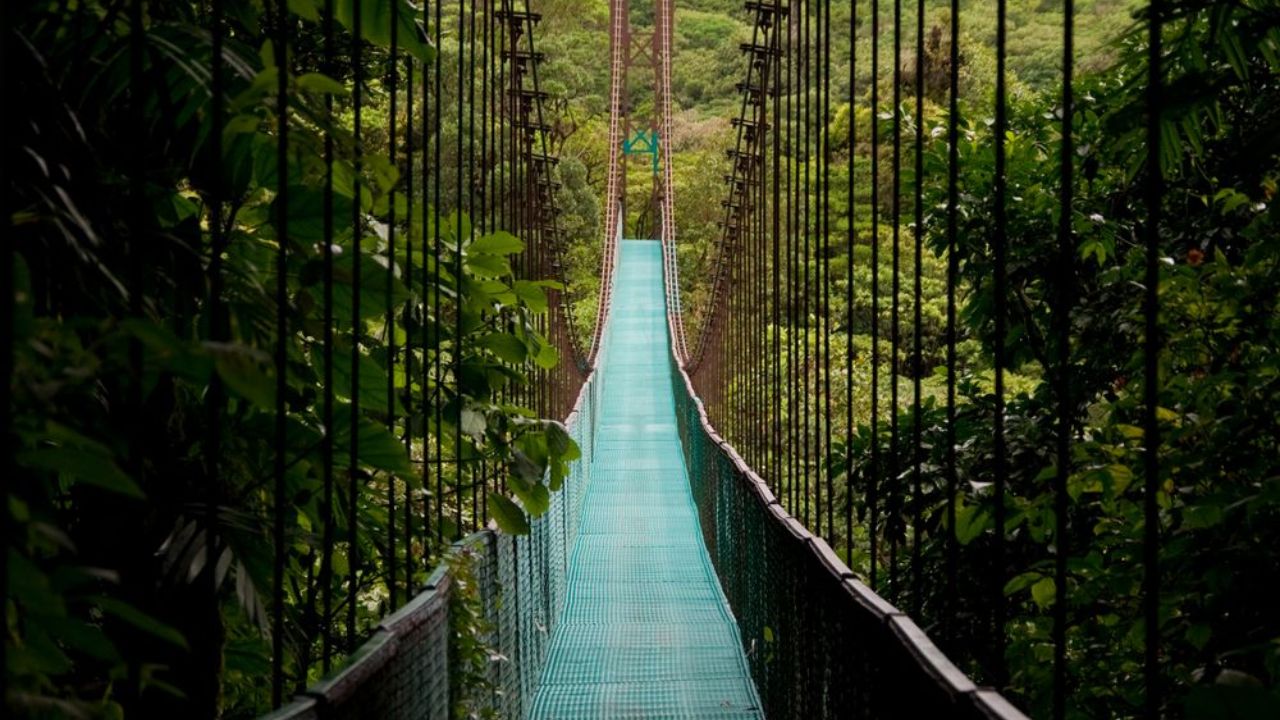 The spectacular hanging bridges of Arenal may not be as old as Cartago but they are just as indicative of the country’s eclectic history as any ancient architecture. A superb 2-mile trail of 16 bridges – a few of which are hanging – take you on a whirlwind tour through the virgin rainforests of Arenal, as they transition from highland to lowland ecosystems, displaying flora and wildlife native to all. An interactive and unforgettable trip through the natural history of the region, the hanging bridges of Arenal offer an unrivalled chance to explore and admire more than otherwise possible from ground level.
Frequently Asked Questions
What are the most famous landmarks in Costa Rica?
The most famous include Arenal Volcano National Park (iconic cone-shaped volcano), Manuel Antonio National Park (pristine beaches and accessible wildlife), Guayabo National Monument (most significant archaeological site), and San Jose’s National Theater (architectural masterpiece).
Natural landmarks like Poas Volcano’s crater and Monteverde Cloud Forest attract hundreds of thousands of visitors annually, while cultural sites like Cartago’s Basilica remain important pilgrimage destinations.
How many days do I need to visit Costa Rica’s landmarks?
Minimum 5-7 days to see major highlights without rushing. San Jose’s museums require 1-2 days. Natural landmarks like Arenal, Manuel Antonio, and Monteverde each deserve 1-2 days for proper exploration. A comprehensive landmarks tour covering both cultural sites and natural wonders needs 10-14 days.
Strategic approach: Combine landmarks by region—Central Valley cultural sites (San Jose museums, Cartago, Poas, Irazu) in 3 days, then northern region (Arenal, Rio Celeste, Monteverde) in 3-4 days, finishing with Pacific coast (Manuel Antonio) for 2 days.
Do I need a guide to visit these landmarks?
Not required for most but highly valuable for several:
Definitely hire guide:
- Guayabo National Monument (ruins don’t reveal significance without expert explanation)
- Monteverde (spotting sloths, quetzals requires trained eyes and scopes)
- Corcovado (mandatory—remote wilderness requires experienced guide)
Worth considering:
- Manuel Antonio (guides find wildlife hidden in canopy—$25-35 well spent)
- Arenal (geology and history add depth to volcano viewing)
Not necessary:
- Poas, Irazu (short, straightforward volcano overlooks with signage)
- National Museum, Gold Museum (excellent bilingual exhibits)
- Rio Celeste (clear marked trail, waterfall obvious)
Are Costa Rica’s landmarks safe to visit?
Yes, very safe. Popular sites have good infrastructure, parking, and facilities. National parks employ rangers, maintain trails, and enforce safety protocols.
Standard precautions:
- Active volcanoes (Poas): Follow ranger instructions, wear provided hard hats, evacuate if ordered
- Wildlife: Maintain distance from animals, don’t feed monkeys, watch for snakes on trails
- Theft: Don’t leave valuables visible in cars at trailheads, watch belongings on Manuel Antonio beaches
- Weather: Check forecasts before mountain trips, avoid hiking during heavy storms
Remote areas (Corcovado, Guayabo): Require more preparation but guided tours manage safety.
How much does it cost to visit landmarks in Costa Rica?
National parks: $12-18 USD per person Museums: $5-11 USD per person Churches/ruins: Often free (Cartago Cathedral Ruins, Basilica) Guided tours: $25-35 per person for half-day naturalist tours
Daily budget including transportation:
- Self-drive + self-guided: $30-50 per person (entrance fees + fuel)
- Organized tours: $60-120 per person (includes transport, guide, often meals)
Free options: National Museum and Gold Museum (Sundays), Cartago’s ruins and basilica (always free), several San Jose architectural landmarks viewable from streets.
Can I visit multiple landmarks in one day?
Yes, if grouped strategically by region.
Central Valley combinations (all feasible in one long day):
- Poas Volcano (morning) + Cartago Basilica + Irazu Volcano (afternoon)—requires early 6am start
- San Jose National Museum + Gold Museum + National Theater (all within 10-minute walk)
- Guayabo + Turrialba town + partial Orosi Valley
Not recommended to do in the same day and why:
- Arenal + Monteverde (3.5-hour drive between them, each deserves full day)
- Manuel Antonio + anything else (3+ hours from most landmarks, needs early arrival)
- Multiple northern region volcanoes (distances too great without extremely long day)
Best approach: Pick 1 major natural landmark + 1-2 nearby cultural sites per day. Trying to squeeze in 3+ major destinations leads to rushed visits and excessive driving.
Conclusion
Visiting national landmarks in Costa Rica grants you the chance to explore both the natural wonders and cultural treasures that make this country one of the world’s most rewarding destinations. From pre-Columbian archaeological sites revealing sophisticated ancient civilizations to active volcanoes showcasing the raw power of our planet, these 14 landmarks tell Costa Rica’s complete story.
The beauty of Costa Rica’s landmarks lies in their accessibility; most can be visited as day trips from San Jose or seamlessly integrated into adventure itineraries. Whether you have 3 days to explore Central Valley museums and volcanoes or 2 weeks to journey from Monteverde’s cloud forests to Manuel Antonio’s beaches, these sites provide the perfect balance of nature, history, and culture.
Don’t limit your Costa Rica experience to beaches and adventure tours alone. The landmarks covered in this guide complement the rainforests, rivers, and coastlines, creating a comprehensive understanding of this remarkable nation.
For comprehensive and eclectic adventure tours of Costa Rica that incorporate landmark visits alongside thrilling activities, simply contact us. Our expert guides can customize itineraries combining the landmarks that most interest you with the adventures you crave.


