

The Best Mountain Bike Trails in Costa Rica For All Skill Levels
Love mountain biking on your active vacation? Then you’re in luck! With so many options and fantastical landscapes, Costa Rica offers a wealth of brilliant mountain bike trails
If we didn’t know any better, we’d say that Mother Nature designed Costa Rica to satisfy the thrill-seeking needs of those who love adventure vacations.
Here are some of the best mountain biking trails to explore on your next Costa Rica adventure vacation:
If there were ever a country purpose-built for adventure on two wheels, Costa Rica would be it. Vertiginous volcanoes, rolling cloud-forest ridgelines, coastal jungle singletrack, and sun-scorched Guanacaste trails all wait here, connected by a culture that celebrates outdoor living at every turn. Below are the best mountain biking trails in Costa Rica, followed by everything a rider needs to plan the trip of a lifetime.
Here are some of the best mountain biking trails to explore on your next Costa Rica adventure vacation:
#1 Ruta de los Conquistadores
| Distance
Pacific to Caribbean coast (~300 km total race route) |
Elevation
Over 18,000 ft cumulative gain over 3 days |
Difficulty
Expert (full route) / Intermediate (sections) |
Type
Multi-day / Point-to-point |
Est. Time
3 days (race) / Flexible (sections) |
 This mammoth trail is used for the yearly multi-stage mountain bike race that’s considered the first of its kind in the world. Professional bikers head here from every corner of the world to complete in a long and arduous track that crosses rivers, mud tracks and rises and falls sharply over its 250-mile distance.
The NY Times called this the toughest bike race in the world. The route crosses Costa Rica from the Pacific to the Caribbean in the north (from Puntarenas in the west to Limon in the east) and passes through sensational landscapes comprising high-elevation passes, steep valleys, forests and jungles, brimming with wildlife. Before you hyperventilate at the sheer thought of tackling the Route of the Conquerors, however, do note that you need not be an exceptional athlete to enjoy sections of the route. Certain stretches are not only super stunning but also not so difficult for experienced mountain bikers. If you’d like a challenge – but not a colossal trial – keep this one in mind.
The Puntarenas to San Ramon stage, for example, climbs through agricultural land and secondary forest before entering the high cloud forests above 3,000 meters, offering extraordinary riding even without attempting the full race format.
The Ruta de los Conquistadores race itself is staged annually, typically in late October or early November, and draws elite and amateur riders from across the globe.
Those who want a challenge without a colossal multi-day trial should consider riding a single stage as a self-guided adventure, with a support vehicle carrying gear between start and finish points.
The diversity of terrain encountered in a single stage, moving from humid lowlands through temperate highland forest to Caribbean jungle, is simply unmatched anywhere else in Central America.
Wildlife Highlight: Riders pass through at least five distinct microclimates along the full route, moving from Pacific coastal forest through cloud forest to Caribbean rainforest. Howler monkeys, white-faced capuchins, toucans, resplendent quetzals at elevation, and an extraordinary diversity of tropical birdlife accompany riders throughout, with wildlife density increasing significantly in the upper highland sections.
Practical Note: For riders planning to tackle sections independently, the Camino de Costa Rica organization provides a mapped route that largely follows the Ruta de los Conquistadores corridor using singletrack and secondary dirt roads, avoiding dangerous paved highways. GPS files are available for download, and the Trailforks app carries meaningful coverage of the key technical sections near the Caribbean descent.
#2 Los Senderos de Colon
| Distance
Over 20 miles (32 km) of interconnected trails |
Elevation
Variable, with steep climbs and long descents |
Difficulty
Beginner to Advanced |
Type
Singletrack and dirt road network |
Est. Time
Half-day to multi-day |
Over 20 miles comprising dozens of trails make up Los Senderos de Colon, a privately-owned mountain biking estate near Colon, an arty town in the San Jose Province, close to the capital city. With an array of trails suitable for beginners and plenty for experienced riders alike, this park is a fabulous choice for first-time biking vacations. On a single or multiple-day excursion here, you can bike past local farms and discover hidden waterfalls as you follow trails of diverging elevations.
The network is organized so that beginners can build confidence on gentler farm-road sections before naturally progressing into the singletrack forest areas where the terrain becomes more demanding.
Steep climbs, techy trails, and sweet downhill sections make this a fab all-rounder that rewards multiple visits with different routes each time. The flow trails in the lower sections of the park are among the smoothest in all of Costa Rica, with bermed corners and rhythm sections that generate real speed.
Los Senderos de Colon sits at an elevation that keeps it noticeably cooler than the Pacific coast and lower Central Valley, making it a particularly pleasant riding destination even in the drier months when coastal temperatures become uncomfortable.
The proximity to San Jose and the international airport makes it an ideal destination for adding a riding day at the beginning or end of a broader Costa Rica adventure itinerary, without requiring significant additional travel time. A detailed map of all the trails on offer is available via Trailforks, where the Los Senderos de Colon region has solid community coverage with updated trail conditions.
Steep climbs, techy trails and sweet downhill sections make this a fab all-rounder. Visit this page for a detailed map of all the trails on offer.
Wildlife Highlight: The trail network weaves through secondary forest and farmland that creates rich edge habitat for wildlife. White-faced capuchin monkeys move through the canopy above the singletrack sections, coatis forage along the trail edges in the early morning, and the birdlife throughout the estate includes toucans, motmots, and a large number of migratory species passing through the Central Valley corridor during seasonal transitions.
Practical Note: Los Senderos de Colon operates as a private estate, and access arrangements should be confirmed in advance of a visit. Guided tours can be organized through operators based in San Jose, and the location approximately 25 kilometers west of the capital means that riders can combine a morning at the trails with an afternoon in the city without any logistical difficulty.
#3 Nicoya Peninsula West Coast Trail
| Distance
Flexible (Tamarindo south along the coast) |
Elevation
Moderate, undulating coastal terrain |
Difficulty
Intermediate |
Type
Dirt tracks, beach sections, river crossings |
Est. Time
Multi-day (customizable) |
Not an official bike trail but certainly a very titillating itinerary, the Nicoya Peninsula’s western coast offers an incredibly adventurous option to those who wish to tackle a multi-day biking and even multi-activity vacation. Costa Rica’s wild west is a spectacular choice, especially when you’ve got a team of logistical assistants to help!
The sense of riding through one of Costa Rica’s most beautiful and least developed coastlines on a mountain bike rather than in a vehicle is something that stays with riders long after they return home.
Start from Tamarindo (a convenient starting point) and head south along the dramatic and undulating coastline, riding on dirt tracks and along deserted beaches (keeping your eyes peeled for turtles) and tackling many fantastic river crossings.
The river crossings are a signature feature of this route and range from shallow knee-deep fords that any rider can manage, to thigh-deep crossings during the green season that require careful assessment before committing. Keeping eyes open for sea turtles along the beach sections at dawn or dusk is one of the memorable side experiences that this coastal route uniquely delivers.
The wonderful thing about this coastal stretch is that there are quite a few towns strewn along the route, including Junquillal, Ostional, Nosara, Garza, and Samara, so the bike journey can be extended or shortened entirely according to preference.
Riders can spend two or three days covering the full southern Nicoya coast, or choose to tackle a single coastal section as a day ride from one of the beach towns along the way. The network of back roads connecting these communities is used by local farming traffic and sees minimal tourist vehicle presence, giving riders a genuine sense of riding through authentic Nicoya coastal life.
Wildlife Highlight: The Nicoya Peninsula coastline is one of the world’s most significant sea turtle nesting zones. Ostional Wildlife Refuge along this route sees some of the largest Olive Ridley sea turtle arrivals in Costa Rica, and beach riding at the right season means sharing the sand with turtles making their way ashore after dark. Howler monkeys sound off from the tree line above the coastal forest sections throughout the day, and white-faced capuchins are regularly visible in the trees above the beach approaches.
Practical Note: Tidal timing is essential for beach sections of this route, as certain passages are only rideable at low tide. Downloading a local tide chart before departure is strongly advisable. River crossings during the green season from May through November can be significantly deeper than in the dry season, and local knowledge from guesthouse owners along the route is invaluable for assessing current conditions before committing to a particular day’s riding plan.
Nosara, one of the key towns along this coastal route, is also one of Costa Rica’s finest surfing destinations; ideal for extending a biking trip into a multi-sport coastal adventure.
#4 Nicoya Peninsula – Jicaral to Montezuma
| Distance
Approx. 36 miles (58 km) |
Elevation
Half a mile (approx. 800 m) total elevation |
Difficulty
Intermediate |
Type
Dirt roads, countryside, beach sections |
Est. Time
1 to 2 days |
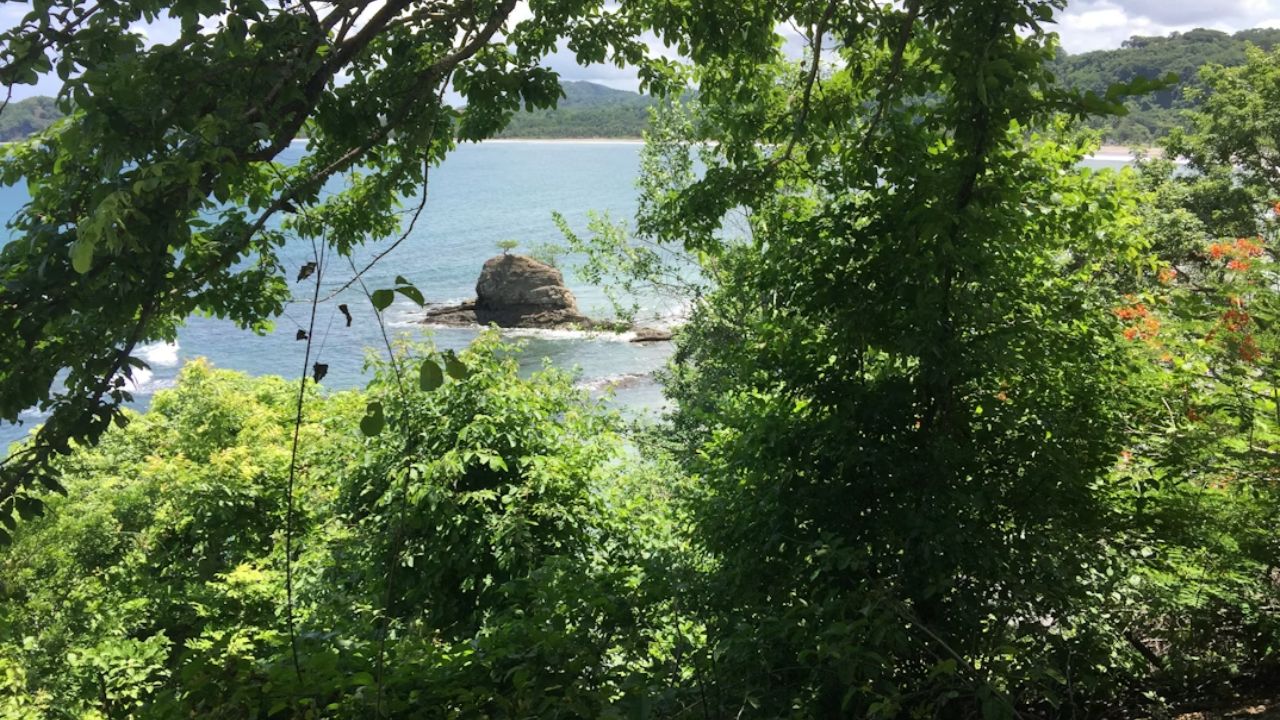
Addicted to biking the Nicoya? Then don’t stop there! The brilliant route from Montezuma (south-west) to Jicaral (north-east) is a favorite among mountain biking circles and offers a totally different adventure to the coastal trail.
The route crosses the interior of the southern Nicoya Peninsula, moving through farming countryside, forested ridgelines, and small villages before descending to the coast, and then alternates between inland dirt roads and beach sections as it progresses toward the ferry crossing at Jicaral that connects back to the mainland.
It is a stunning trail that delivers a plethora of glorious scenery while taking riders on dirt roads through the beautiful Nicoya countryside, with enough beach sections to satisfy sea-lovers and enough inland variation to hold the interest of riders who would otherwise find a purely coastal route repetitive. The Montezuma end of the route is particularly beautiful, with the town sitting above dramatic rocky beaches and a famous waterfall accessible on foot from the village.
The route can be ridden in either direction with equal rewards, though most riders choose to start from the relative quiet of Montezuma and ride toward the ferry at Jicaral to keep logistics straightforward.
Montezuma has a well-established small-town tourism infrastructure with good accommodation, fresh food options, and a laid-back atmosphere that makes it an enjoyable base for the night before an early departure. The ferry crossing at Jicaral connects to Puntarenas on the mainland in approximately one hour, making this an ideal route segment within a broader Costa Rica riding itinerary that begins or ends in San Jose.
Wildlife Highlight: The inland Nicoya countryside on this route harbors a rich variety of bird species including parrots, motmots, and kingfishers along the river sections. White-tailed deer are regularly spotted grazing near trail edges in the early morning. The coastal sections near Montezuma pass close to the Cabo Blanco Absolute Nature Reserve, one of Costa Rica’s oldest protected areas, where howler monkeys and white-faced capuchins are reliably visible from the trail approaches.
Practical Note: The ferry schedule from Jicaral to Puntarenas runs multiple times daily and is the most straightforward return route to San Jose or onward destinations. Booking the night before departure in Montezuma during high season is strongly advised, as the town’s small accommodation options fill quickly from December through April. Bike-friendly guesthouses in Montezuma can advise on the best departure time to catch favorable tidal conditions for the beach sections.
It stretches for about 36 miles and boasts half a mile of elevation. It’s a stunning trail that offers a plethora of glorious scenery whilst taking you on dirt roads through the beautiful Nicoya countryside and having enough beach sections to satisfy sea-lovers.
#5 Nosara to Limon – Cross-country Trail
| Distance
Approx. 300 miles (480 km) full route |
Elevation
2.5+ miles (4+ km) cumulative elevation gain |
Difficulty
Advanced |
Type
Trails and secondary roads, Pacific to Caribbean |
Est. Time
7 to 10 days (full route) |
Here’s one that – at least in distance – rivals Los Senderos de Conquistadores. Want to cross Costa Rica from west to east whilst exploring the amazing delights of the Central Valley? Then this amazing 300-mile challenge is for you!
Those who want to cross Costa Rica entirely under their own power while experiencing the amazing ecological diversity of the Central Valley will find this one of the most rewarding cycling challenges in all of Central America.
Start on the Pacific Coast an enjoy the next week ascending over 2.5 miles through the Guanacaste Province along the shores of Lake Arenal, east to Tabacon and La Fortuna and onwards to Puerto Viejo and south to Limon. Take advantage of trails and secondary roads to keep well away from traffic and enjoy a truly superlative experience, remembering that even doing just a section of it is immensely rewarding.
Take advantage of trails and secondary roads to keep well away from traffic and enjoy a truly superlative experience, remembering that even doing just a section of it is immensely rewarding.
The route passes through small farming communities where fresh fruit is available roadside, and where a bicycle rather than a car remains a primary form of daily transport for many residents.
Even completing just a single section of this ambitious route is immensely rewarding. The Lake Arenal segment alone, for example, covers some of the most photogenic terrain in Costa Rica and can be ridden over two or three days as a standalone adventure.
Riders who plan to tackle the full route should budget carefully for varying weather conditions, as the route crosses multiple distinct climate zones where packing for cool highland temperatures and warm Caribbean humidity simultaneously is genuinely necessary. Secondary roads and established dirt tracks used by the Camino de Costa Rica initiative largely mirror this routing and provide GPS track files, removing navigation uncertainty.
Wildlife Highlight: The cross-country route passes through some of Costa Rica’s most biodiverse regions in sequence, from Pacific dry forest supporting deer and coatis, through cloud forest home to quetzals and bellbirds, to Caribbean lowland rainforest sheltering poison dart frogs, three-toed sloths, and river otters. The section following the Caribbean slope from La Fortuna toward Limon is particularly rich, with jungle canopy pressing close to the trail and an extraordinary soundscape of birds, insects, and howler monkeys audible from before dawn.
Practical Note: The full route requires careful planning of water resupply points, as some sections pass through agricultural land with limited access to safe drinking water. Carrying a portable water filter is strongly advisable. The Camino de Costa Rica network provides some hospitality and accommodation options along the route corridor, and contacting them in advance provides access to a full logistics guide for independent riders.
#6 La Angelina Mountain Bike Park, Cartago
| Distance
Approx. 19 km of singletrack |
Elevation
Steady sustained climb followed by steep descent |
Difficulty
Intermediate to Advanced |
Type
Singletrack only |
Est. Time
Half-day to full day |
Considered the best single-track route in all of Costa Rica, La Angelina offers a steady climb, sensational switchbacks, superb views and a smooth and steep descent. that delivers the kind of momentum that serious singletrack riders spend years chasing.
An excellent workout, an unforgettable day out, and a wilderness setting of rare quality combine here to create what is genuinely the benchmark Costa Rica mountain biking experience for technically confident riders. Walking or jogging companions can come along for the wonderful views and for a chance to stretch their legs, as there are plenty of trails in the park suitable for non-riders.
The trail begins with a moderate but sustained climb from the park entrance, moving through forest sections with a well-maintained trail surface that gives riders time to warm up before the grade steepens.
As elevation increases, the vegetation transitions from secondary forest into cloud forest fringe, with mossy trees, bromeliads, and orchids appearing along the trail corridor. Sensational switchback sections in the upper portion of the climb require real technical skill to ride cleanly, and it is here that La Angelina earns its reputation among advanced riders.
The views over Cartago Province and the surrounding valley from the upper trail sections make every pedal stroke on the climb genuinely worthwhile, and the summit area allows riders a moment to take in the panorama before committing to the descent.
The descent at La Angelina is the ride that most riders travel specifically to experience. Long, fast, gravity-fed, and featuring a mix of smooth flow sections and more technical rock and root features, it generates a quality of momentum that keeps riders grinning well after the trail levels off at the bottom.
The trail is maintained to a high standard and the descent line is clear enough that intermediate riders who are comfortable with speed can enjoy it fully, though the technical upper sections on the climb genuinely demand advanced proficiency. La Angelina is located close enough to San Jose to function as an excellent full-day excursion from the capital without overnight accommodation requirements.
Wildlife Highlight: The cloud forest sections of La Angelina shelter resplendent quetzals, which are occasionally spotted in the misty upper trail sections during the quetzal nesting season from February through April. Emerald toucanets are a reliable sighting year-round, and the rich diversity of orchids and bromeliads clinging to the mossy canopy above the upper trail creates one of the most visually spectacular natural environments of any Costa Rica riding area.
Practical Note: La Angelina is best visited on a guided tour arranged through operators based in San Jose or Cartago, who provide bike and helmet hire along with trail guidance on the more technical sections. Arriving early in the morning is advisable, as cloud cover builds through the afternoon in this highland area and can reduce visibility on the descent. The park is located in the mountains above Cartago city, approximately one hour by road from central San Jose.
#7 Las Catalinas Bike Trails, Guanacaste
| Distance
Over 10 miles (16 km) of trails |
Elevation
Variable, mostly rolling coastal terrain |
Difficulty
Beginner to Intermediate |
Type
Over 90% singletrack |
Est. Time
2 to 4 hours |
A stunning trail system through the wilderness which frames Las Catalinas – the Pacific Coast’s recently developed hub – offers a kaleidoscope of trails for cyclists and walkers alike. Fabulous coastal views have earned the reserve top marks and it’s often been dubbed ‘the most beautiful mountain biking route in the topics’. There are over 10 miles of track to explore, 90% of which is single-track, all offering breathtaking views across the Pacific Coast. You’ll be surrounded by a flurry of exotic birds and will have to keep your eyes out for wild hogs, coatis and monkeys.
The trails vary from mellow flow sections suitable for beginner,s gaining confidence on natural terrain, to more technical rocky stretches and steeper descent lines that satisfy experienced riders seeking genuine challenge.
The entire network can be ridden in a single half-day session, though most visitors return for multiple laps to explore the various route combinations and to enjoy the experience of riding in different light conditions as the day progresses.
Las Catalinas itself is a thoughtfully designed pedestrian community with no vehicle traffic, excellent accommodation, and good food options that make it an ideal base for a one or two-night stay organized around the trails.
The town sits directly beside the trailhead, meaning riders can step directly from their accommodation onto the singletrack without any transport requirements. Riders will be surrounded throughout the trail system by a flurry of exotic birds and will need to keep eyes open for wild pigs, coatis, and monkeys, all of which move confidently through the trail corridor and occasionally pause long enough for photographs.
Wildlife Highlight: The dry tropical forest surrounding the Las Catalinas trail system supports an impressive array of wildlife year-round. White-nosed coatis are particularly bold and frequently cross the trail just meters ahead of passing riders. Spider monkeys and howler monkeys inhabit the taller trees along the upper sections of the network, and the trail edges at dawn and dusk are excellent locations for spotting the broad range of resident and migratory bird species that have been recorded in this coastal forest system.
Practical Note: Las Catalinas trails are shared with walkers and hikers, so maintaining a courteous and controlled speed on blind corners is genuinely important for everyone’s enjoyment and safety. Guided mountain bike tours in Las Catalinas typically run for approximately 2.5 hours and are priced at around $110 per person, with quality mountain bikes and helmets included. The trails are open year-round and the dry forest environment means they remain in reasonable condition even during the green season when Pacific singletrack in other areas can become very muddy.
#8 Arenal Volcano Region, La Fortuna
| Distance
Over 10 miles (16 km) of trails |
Elevation
Variable, mostly rolling coastal terrain |
Difficulty
Beginner to Intermediate |
Type
Over 90% singletrack |
Est. Time
2 to 4 hours |
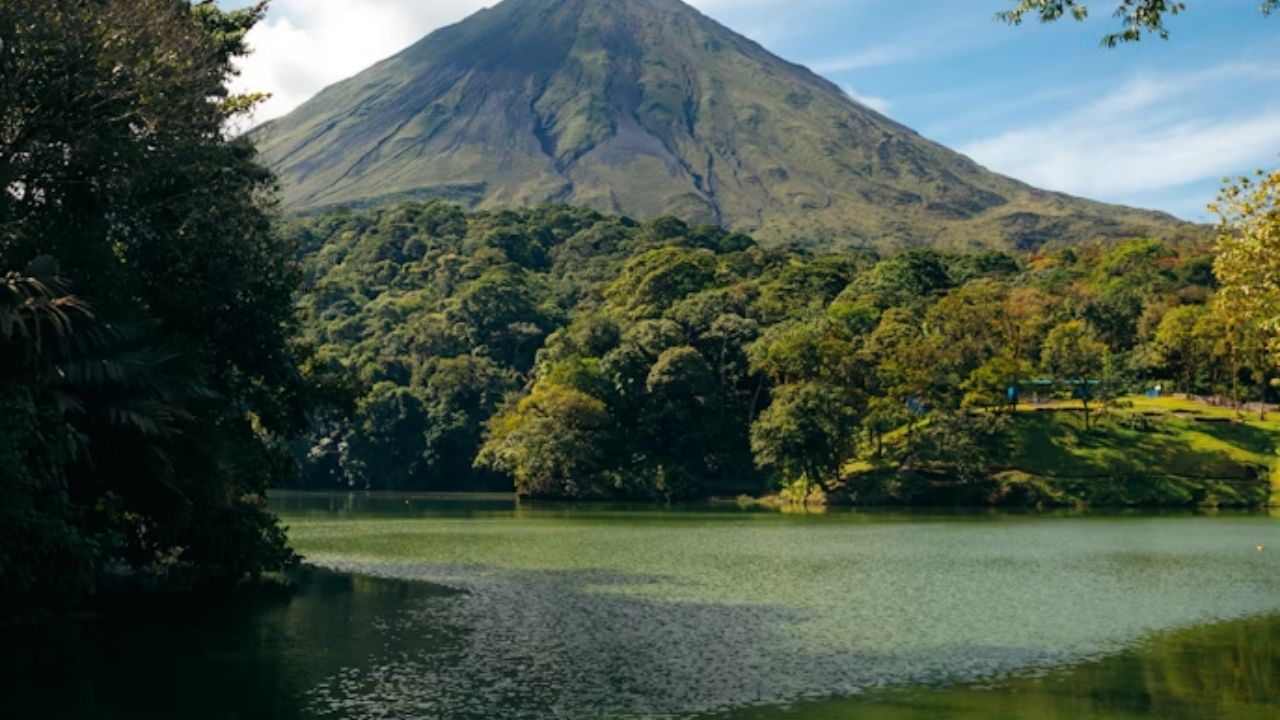
The Arenal Volcano region consistently ranks as the single most popular mountain biking destination in all of Costa Rica, and the reasons become immediately obvious the moment a rider arrives in La Fortuna.
With the iconic cone of Arenal Volcano rising as a constant backdrop and the shimmering expanse of Lake Arenal stretching for nearly 33 kilometers beside the trail, almost every pedal stroke comes with a view that would look staged in a travel magazine.
The region suits all ability levels and offers more variety within a single geographic area than almost anywhere else in the country, making it the ideal anchor destination for any Costa Rica riding itinerary.
The most accessible and beloved route follows the southern and eastern shores of Lake Arenal, beginning from the small town of Foforos or from La Fortuna itself. The gravel and dirt road weaves through farmland, dense jungle terrain, river crossings, and small streams over a 24-kilometer stretch.
The road surface is firm enough for all skill levels during the dry season, and the altitude of roughly 540 meters above sea level keeps temperatures noticeably cooler than the Pacific coast, making riding conditions exceptionally comfortable even in the middle of the day.
For riders seeking more technical challenges, the Mt. Arenal Observatory Volcano route is a rewarding 9-mile intermediate loop with 1,535 feet of climbing, reaching a high point of 2,627 feet, passing through the national park boundary with sweeping changing volcano views, and finishing with a fast descent back toward the lake.
A separate and highly memorable option is the dirt road running from the El Castillo area along the far southern shore of the lake toward Rancho Margot. After a short river crossing at the El Castillo road end, riders find themselves on a virtually deserted track with enormous views, rocky terrain, and a quality of solitude that is increasingly rare in popular national park regions.
Tours from La Fortuna can also be combined with the iconic La Fortuna Waterfall, pedaling toward the trailhead before descending to swim in the waterfall pool as a mid-ride reward. The Arenal route additionally serves as a natural one-way connection point toward Monteverde or the Nicoya Peninsula for riders planning a multi-region Costa Rica riding itinerary.
Wildlife Highlight: Howler monkeys are heard and frequently seen throughout the Arenal trail network, particularly in the forest sections near El Castillo where the tree cover thickens above the trail. Coatis are common companions along the lake road, appearing to scavenge and forage with complete indifference to passing cyclists. The wider Arenal Volcano National Park records over 500 bird species, including toucans, kingfishers, herons, and multiple species of tanager that flash color from the trailside vegetation throughout the day.
Practical Note: Guided tours depart La Fortuna at 8 am and 1 pm daily from several well-established operators. Most tour packages include transport to the trailhead, bike, helmet, bilingual naturalist guide, and a mid-ride snack at the lake shore. Pricing typically ranges from $60 to $80 per person for a half-day guided experience. Riders who prefer to explore independently can hire quality bikes from La Fortuna town and navigate using Trailforks or the Ride with GPS app, both of which have good coverage of the established Arenal routes.
#9 Manuel Antonio and Quepos, Central Pacific
| Distance
23 km to 55 km depending on tour |
Elevation
Up to 3,278 ft on longer routes |
Difficulty
Beginner to Expert |
Type
Jungle singletrack, dirt roads, coastal paths |
Est. Time
2 hours to full day |
Manuel Antonio National Park may be celebrated internationally for its white-sand beaches and extraordinary wildlife density, but the mountain biking trails spreading through the jungle hills surrounding Quepos and the park itself represent one of Costa Rica’s most atmospheric riding experiences.
Riders pedal through steamy tropical forest alive with bird calls at every turn, past hidden waterfalls set back from the trail behind screens of giant ferns, and along ridgelines where sudden Pacific Ocean views appear through gaps in the dense canopy.
The combination of jungle immersion and coastal panorama within a single ride is a quality that this region uniquely delivers in the Central Pacific.
The Quepos mountain biking network operates on multiple clearly defined routes matched to different ability levels, making this one of the most accessible areas in Costa Rica for riders of all backgrounds.
Beginner-friendly options include a 23-kilometer boat and bike combination tour that pairs paddling through mangrove river channels with cycling through the park’s surrounding countryside.
A 23-kilometer sunset and evening ride is also available for those who want to experience the atmosphere of the Pacific light fading over the ocean from the jungle ridges above. Intermediate riders gravitate toward the Paso Real trail at 25 kilometers, which delivers a satisfying mix of jungle climbs and coastal descents.
Advanced riders and those seeking a genuine physical challenge tackle the Killer Loop at 55 kilometers or the Rodeo trail at 42 kilometers, both involving sustained climbing into the mountains above the coastline before a long gravity-assisted return.
The inland mountain road toward the village of Naples above Quepos is particularly worth noting for those comfortable with significant climbing. The ascent from the coast to the mountaintop is genuinely demanding with several steep pitches that will test experienced riders, but the descent from the summit back toward Manuel Antonio is one of the most exhilarating downhills in the entire Central Pacific region.
Organized tours can arrange vehicle shuttles to the top so that riders focus purely on the descent, which is an ideal option for those who want to experience the trail’s reward without the full climbing commitment.
Bilingual naturalist cycling guides on all organized tours are expert at spotting wildlife from the trail, transforming what would otherwise be a purely athletic experience into a rich natural history encounter.
Wildlife Highlight: Manuel Antonio National Park records over 100 species of mammals and 184 bird species within a remarkably small geographic area. Mountain bikers moving through the jungle trails on guided tours regularly encounter three-toed sloths draped over Cecropia trees, squirrel monkeys crossing the trail in fast-moving energetic troops, white-faced capuchin monkeys, green iguanas sunning on exposed roots, and toucans moving between fruiting trees above the singletrack. The density of visible wildlife per hour of riding here is exceptional by any standard.
Practical Note: Guided tours operate year-round from Quepos town, with bilingual naturalist cycling guides who customize routes based on rider fitness and interests on the day. Bikes, helmets, and in many cases lunch at a local ranch are included in full-day tour pricing. The boat and bike beginner combination tour is a particularly popular option for families with mixed abilities, as the boat section can be extended and the cycling portion shortened without affecting the overall experience quality.
#10 Monteverde and Santa Elena Cloud Forest Region
| Distance
15 to 25 km per guided tour on back roads |
Elevation
Rolling hills, rated 5 to 6 out of 10 difficulty |
Difficulty
Beginner to Advanced (three tour tiers) |
Type
Paved back roads and remote dirt roads |
Est. Time
2 hours per tour session |
Mountain biking in Monteverde is an experience of an entirely different character to anything available on Costa Rica’s coasts or in the national park trail systems. Sitting on the Continental Divide at around 1,500 meters above sea level, the Monteverde and Santa Elena region wraps riders in cool mountain air, perpetual mist, and some of the most concentrated biodiversity per square kilometer on the planet.
The cloud forest setting transforms a standard back-road trail ride into something that feels genuinely otherworldly, with thick clouds rolling across the ridgelines, bromeliads dripping from every surface, and bird calls filling the air from before dawn to well after dusk.
Guided mountain biking tours in Monteverde operate on three distinct tiers designed to accommodate a wide range of rider abilities. The regular tour covers local back roads with minimal traffic and gentle rolling hills, designed for riders with moderate skill levels who want to enjoy the highland scenery and cool mountain air without technical riding demands.
Morning tours depart at 9 am and afternoon tours at 2:30 pm, fitting conveniently around other Monteverde activities. The private tour provides personalized routing on more remote back roads based on rider ability and stated interests.
The VIP tour, designed for experienced and fit mountain bikers, ventures into remote mountain terrain and forest tracks with dramatic volcano views appearing on clear days, delivering the kind of riding that serious cyclists travel specifically to find. All tours carry a difficulty rating of 5 to 6 out of 10, last approximately 2 hours, and include quality bikes, helmets, fresh fruit, and beverages.
Beyond the organized guided tours, mountain biking the back roads connecting the farming communities of Santa Elena, Monteverde, and the surrounding high-altitude agricultural country allows independent riders to discover local artisan cheese farms, small coffee plantations producing some of Costa Rica’s finest highland beans, and viewpoints that look out over both the Pacific slope and the Caribbean slope simultaneously.
The Continental Divide viewpoint accessible from these back roads is one of the rare places in all of Costa Rica where both coasts are theoretically visible in a single panoramic glance, and the experience of standing at that perspective after arriving by bicycle is one that no vehicle-based visitor ever has.
Wildlife Highlight: Monteverde shelters approximately 500 species of birds, 120 mammals, 100 reptiles, and 60 amphibians within its cloud forest reserves and surrounding habitat. Mountain biking the back roads significantly increases the likelihood of encountering resplendent quetzals, which descend to lower elevations seasonally and are occasionally spotted from roadside trees during the March and April nesting peak. Three-wattled bellbirds call from the canopy above the road corridor, and the cloud forest’s extraordinary chorus of insects and frogs builds from late afternoon onward.
Practical Note: Cloud forest riding requires light layering and a packable rain jacket regardless of season and time of day, as temperature can drop 10 to 15 degrees Celsius compared to coastal locations and mist can arrive rapidly even in the dry season. Riders who combine a two-night Monteverde stay with adjacent destinations including La
#11 Rincon de la Vieja Volcano, Guanacaste
| Distance
12 to 30 km depending on route |
Elevation
926 ft to 2,800 ft depending on circuit |
Difficulty
Beginner to Expert |
Type
Shaded singletrack, forest trails, volcanic terrain |
Est. Time
1.5 hours to full day |
Fortuna or the Nicoya Peninsula are covering some of Costa Rica’s most celebrated ecological territory within a single efficiently structured itinerary.
Rincón de la Vieja is an active volcano in the Guanacaste Province that offers some of the most atmospherically distinctive mountain biking in all of Central America. The trails here are set against a backdrop of bubbling mud pots, steaming thermal vents, dry tropical forest draped in Spanish moss, and river crossings that run warm from geothermal activity, creating a riding environment unlike anywhere else in Costa Rica or the wider region.
The altitude keeps conditions noticeably cooler than the surrounding Guanacaste lowland coast, the shade coverage across the dedicated singletrack network is dense throughout, and the sensation of riding through an active volcanic landscape with steam rising from the ground beside the trail is something that stays with riders permanently.
The primary mountain biking hub in this region is Hacienda Guachipelín, which maintains 30 kilometers of purpose-built, clearly marked singletrack trails at the base of the volcano. Routes are categorized across three difficulty tiers with precise specifications.
The beginner circuit covers 12.5 kilometers, with a 5.5-kilometer ascent and a 7-kilometer descent, completing in 1.5 to 2.5 hours. The intermediate route extends to 16 kilometers with the same 5.5-kilometer climb followed by a longer, rolling 10.5-kilometer descent section, typically completing in 2 to 3 hours.
Advanced riders have access to the full 30-kilometer circuit, which ventures deeper into the national park boundary and delivers significantly more technical terrain including drops, rocky volcanic sections, wooden bridge crossings over thermal streams, and trail features that demand genuine bike handling skill. The hacienda uses only high-quality front-suspension and dual-suspension bikes, a meaningful distinction from many other Costa Rica operators.
The Oropendola trail within the network is particularly beloved, weaving through dry tropical forest, past open cattle pastures with the volcano cone visible throughout the ride, and ultimately leading to the La Oropendola waterfall where a natural swimming pool provides perfect motivation to complete the final climb.
The Jaguarundi trail descent is the return: a fast, largely shaded forest descent crossing wooden bridges built specifically for the bike trail before arriving back at the hacienda adventure center. A separate and more accessible option exists near Liberia at the Rincon Trails MTB complex, which offers a 12-kilometer circular beginner-friendly network for approximately $6 entry, functioning as an excellent warm-up or family-friendly alternative before tackling the more demanding Hacienda Guachipelín routes.
Wildlife Highlight: The trails at Rincón de la Vieja pass through habitat sheltering capuchin monkeys, armadillos, coatis, and on fortunate occasions, tapirs and white-lipped peccaries in the more remote sections of the national park boundary circuit. The dry tropical forest ecosystem here is one of the last protected examples in the region and is home to an extraordinary concentration of bird species including the turquoise-browed motmot, the boat-billed flycatcher, and multiple species of parakeet that move noisily through the canopy above the upper trail sections.
Practical Note: The Hacienda Guachipelín is located approximately 40 kilometers from Liberia on a well-maintained access road that any rental vehicle can handle. Mountain biking tours here combine naturally with zip-lining, river tubing, and horseback riding as part of a comprehensive full-day adventure package, making it one of the most activity-dense single destinations in Guanacaste Province. After the ride, the hacienda’s proximity to natural hot springs and mud bath facilities provides a genuinely therapeutic way to conclude a day of hard riding.
Best Time of Year to Mountain Bike in Costa Rica
Costa Rica has two distinct seasons, and choosing the right time to visit shapes the riding experience meaningfully. Both seasons carry genuine advantages, and the optimal choice depends entirely on the type of experience a rider is seeking.
Dry Season: December to April
The dry season is universally considered the optimal time for mountain biking across the majority of Costa Rica’s trail networks. From December through April, rainfall is minimal on the Pacific side, river levels drop, making crossings easier and safer, and trail surfaces firm up considerably, reducing mud and improving traction on both dirt roads and singletrack.
Temperatures typically range from the mid-60s to the mid-80s Fahrenheit, with highland areas like Monteverde and the Arenal region running noticeably cooler than the coastal trails. February and March are generally the driest months overall and represent peak trail conditions across most of the country.
The tradeoff of the dry season is higher visitor numbers and elevated prices for accommodation and tours across all popular destinations. Booking trail tours and accommodation well in advance, particularly from December through February, is strongly recommended.
The Arenal and Las Catalinas regions in particular see very high demand during this period, and last-minute availability for guided tours becomes very limited from late December through early April.
Green Season: May to November
The green season transforms Costa Rica’s landscapes into something extraordinarily vivid and lush, and mountain biking during this period carries its own distinct appeal for the right rider. Trails are significantly less crowded, tour operators frequently offer lower rates, and the scenery reaches its most saturated and photogenic state.
Rain in Costa Rica during the green season typically arrives in the afternoon rather than throughout the day, meaning early morning rides often depart in full sunshine and complete before the heaviest rainfall arrives in the mid-afternoon.
Trail conditions require more attention and flexibility during the green season. Dirt singletrack can become genuinely muddy and slippery after heavy rain, river crossings rise and require more careful current assessment before entry, and some sections in lower-lying coastal areas can become temporarily impassable following sustained precipitation.
Experienced riders who embrace these conditions often describe green-season riding as the most memorable and authentic of the two seasonal options. The Arenal region remains highly rideable through much of the green season due to its elevation advantage, and the Caribbean coast sees its driest weather from September through November, making that period ideal for the cross-country trails running in that direction.
Year-Round Riding
The Caribbean coast and certain highland microclimates including Monteverde allow for year-round riding with appropriate flexibility in planning. Starting rides early in the morning is the single most effective strategy for avoiding rainfall regardless of season, as clear weather is most consistent between 6 am and noon across most of Costa Rica’s riding regions. The cloud forest areas of Monteverde see some precipitation most months of the year but remain entirely rideable with a packable rain layer and sensible departure timing.
What to Bring and Expect on a Mountain Biking Tour
Essential Gear for Every Ride
Most organized guided mountain biking tours in Costa Rica include bike rental, helmet, and guide services within the tour price. Quality varies between operators, and it is worth confirming that the bikes provided are front-suspension or dual-suspension mountain bikes rather than basic hybrids, particularly for technical singletrack at La Angelina, Hacienda Guachipelín, or Los Senderos de Colon.
Riders bringing personal equipment should note that import duties in Costa Rica make high-end bikes expensive to source locally, so those with specific requirements are better served by travelling with their own equipment.
The following items are recommended for any mountain biking day in Costa Rica regardless of whether the ride is guided or independent:
- Moisture-wicking cycling clothing suited to warm and humid tropical conditions
- Packable rain jacket or light wind layer, particularly for highland rides in Monteverde, Arenal, and La Angelina
- High-factor sunscreen and insect repellent for all trail environments
- Hydration pack or a minimum of two large water bottles per half-day of riding
- Energy-dense snacks, as resupply points are limited on many trail networks outside of town sections
- Closed-toe shoes with solid grip, ideally cycling-specific but sturdy trail running shoes are acceptable
- Basic trail repair kit including a spare tube, tire levers, and a small pump
- Waterproof dry bag for protecting cameras, phones, and valuables during river crossings and green-season showers
Guided Tours vs. Independent Riding
The decision between guided and independent riding carries more practical weight in Costa Rica than in many other mountain biking destinations. Trail networks outside purpose-built parks are not always consistently well-marked, junction signage varies considerably, and river crossings require local knowledge of current conditions to assess safely.
Beyond navigation, naturalist cycling guides add significant value to any wildlife-rich route, as their expertise in spotting camouflaged animals along the trail transforms the riding experience from athletic activity into a genuine natural history encounter. For riders visiting Costa Rica for the first time, at least one guided introduction to the regional trail system is strongly advisable before venturing out independently.
For experienced riders returning to Costa Rica or those comfortable with trail navigation applications including Trailforks and MTB Project, both of which carry meaningful Costa Rica coverage across the major riding areas, independent exploration is entirely viable with appropriate preparation and conservative planning around river conditions.
Typical Tour Pricing
Guided half-day mountain biking tours in Costa Rica typically range from $60 to $110 per person, depending on destination, group size, and inclusions. Full-day tours with lunch and multiple activity combinations generally run from $90 to $150 per person. Bike rental without a guide costs approximately $20 to $30 per day for a standard hardtail mountain bike from reputable operators.
Multi-day riding vacation packages combining accommodation, guided rides, luggage transfer between destinations, and meals represent the most comprehensive and best-value option for riders planning a dedicated Costa Rica riding trip.
Choosing the Right Trail for Every Skill Level
One of Costa Rica’s greatest strengths as a mountain biking destination is the extraordinary range of terrain available across every skill category. The following guide matches ability level directly to the most appropriate trail or region from the options described above.
Beginner and Family-Friendly
- Lake Arenal Loop (La Fortuna): Flat to gently rolling gravel roads, spectacular volcano and lake views, 13 to 22 km, minimal technical challenge, excellent for families
- Las Catalinas (Guanacaste): Mellow coastal singletrack with Pacific Ocean views, shared with walkers, ideal for those new to natural trail riding
- Rincon Trails near Liberia: Purpose-built sector network, 12 km total, designed specifically for beginner and family-friendly riding with a $6 entry fee
- Los Senderos de Colon beginner sections: Gentle farm track and forest paths progressing naturally into more technical areas as confidence builds
- Manuel Antonio beginner boat and bike tour: 23 km with a naturalist guide, no technical riding required, mangrove paddling included
Intermediate
- Nicoya Peninsula West Coast Trail: Multi-day coastal adventure with river crossings and beach sections requiring solid base fitness and navigation confidence
- Jicaral to Montezuma (Nicoya): 36-mile point-to-point across varied countryside, coast, and mixed dirt surfaces over one to two days
- Mt. Arenal Observatory Trail: 9-mile loop with 1,535 ft of climbing, technical but thoroughly manageable singletrack for confident intermediate riders
- Monteverde VIP Tour: Remote back roads and mountain terrain in cloud forest conditions, rated 5 to 6 out of 10 difficulty
- Rincon de la Vieja Intermediate Circuit (Hacienda Guachipelín): 16 km of shaded singletrack with a satisfying sustained climb and a fast descent
- Manuel Antonio Paso Real Trail: 25 km through jungle and coastal terrain, mix of climbing and rewarding descent
Advanced and Expert
- Ruta de los Conquistadores full route or advanced sections: Pacific to Caribbean epic, rated among the toughest multi-day bike challenges in the world
- La Angelina Mountain Bike Park (Cartago): Costa Rica’s finest technical singletrack, demanding switchback climbing and a high-speed sustained descent
- Nosara to Limon Cross-Country: 300-mile coast-to-coast traverse with over 2.5 miles of cumulative elevation gain across 7 to 10 days
- Rincon de la Vieja Advanced Circuit (Hacienda Guachipelín): 30 km of volcanic singletrack with technical drops, rock features, and geothermally warm river crossings
- Manuel Antonio Killer Loop: 55 km with significant mountain elevation gain above the Central Pacific coast
Frequently Asked Questions About Mountain Biking in Costa Rica
Is Costa Rica a good destination for mountain biking?
Costa Rica is widely regarded as one of the finest mountain biking destinations in Central America and among the very best tropical riding destinations globally. The combination of genuinely diverse terrain spanning cloud forest, coastal jungle, volcanic highlands, dry tropical forest, and beach singletrack, along with extraordinary wildlife, excellent guided tour infrastructure, and a culture of outdoor adventure makes it exceptional for riders of every background.
Trails exist for every ability level from complete beginners to elite endurance riders, and the country’s compact geography means that dramatically different riding environments are accessible within short travel distances from any base.
When is the best time to mountain bike in Costa Rica?
The dry season from December to April offers the most reliable trail conditions on the Pacific side, with firm surfaces, lower river levels, and clear morning skies across most of the country’s major riding areas.
February and March are the driest months overall and represent peak trail conditions. The green season from May to November brings extraordinary lushness, significantly fewer crowds, and lower pricing for accommodation and tours, but requires more flexibility around trail conditions. Early morning starts between 6 am and noon are the single most effective strategy for maximizing clear riding weather in any season.
Do riders need to be experienced to mountain bike in Costa Rica?
Not at all. Costa Rica has outstanding options for complete beginners, families with children, and casual riders with no technical mountain biking experience.
The Lake Arenal loop near La Fortuna, the beginner sections at Los Senderos de Colon, the Rincon Trails complex near Liberia, and the beginner guided tours in Manuel Antonio and Las Catalinas all deliver spectacular scenery and memorable experiences without any technical demands.
Expert riders simultaneously have access to some of the most technically demanding singletrack in Central America at La Angelina, the Ruta de los Conquistadores, and the full Hacienda Guachipelín circuit.
What should riders wear and bring for a mountain biking tour in Costa Rica?
Light moisture-wicking cycling clothing suited to warm and humid tropical conditions is ideal. Closed-toe shoes with solid grip are essential across all trail environments. A packable rain jacket is recommended regardless of season, particularly for highland areas including Monteverde, La Angelina, and the Arenal region.
High-factor sunscreen, insect repellent, and sufficient hydration are critical on every ride. Most guided tours provide helmets and bikes. Independent riders should carry a basic repair kit including a spare tube, tire levers, and a pump, along with a waterproof bag to protect electronics and valuables during river crossings and unexpected rain showers.
How much does a mountain biking tour cost in Costa Rica?
Guided half-day tours typically range from $60 to $110 per person, with bikes, helmets, and a bilingual naturalist guide included. Full-day tours with lunch generally run from $90 to $150 per person. Bike rental without a guide costs approximately $20 to $30 per day for a standard hardtail mountain bike from reputable operators.
Multi-day riding packages that combine accommodation, guided rides across different regions, and luggage transfer offer the most comprehensive experience and the best overall value for riders whose primary purpose in visiting Costa Rica is mountain biking.
Are rental bikes good quality in Costa Rica?
Quality varies significantly between operators and locations. Reputable guided tour companies at the major mountain biking destinations including La Fortuna, Quepos, Las Catalinas, and Hacienda Guachipelín at Rincón de la Vieja maintain modern, well-serviced bikes with front suspension and reliable current-generation components.
Purpose-built parks like Hacienda Guachipelín additionally offer dual-suspension bikes for the more technical circuit options. Independent bike shops at smaller beach towns may carry older or less consistently maintained fleets.
Confirming bike specifications directly with an operator before booking is advisable, particularly for technical singletrack where suspension quality and brake performance are genuinely important.
Can mountain biking be combined with other activities in Costa Rica?
Combining mountain biking with other adventure activities is one of Costa Rica’s most celebrated travel formats. Hacienda Guachipelín at Rincón de la Vieja offers biking alongside zip-lining, river tubing, waterfall swimming, and horseback riding within a single full-day package.
The Arenal region pairs lake biking with hot springs at Tabacón, white-water rafting on the Balsa or Toro rivers, and hanging bridge canopy walks. Manuel Antonio combines biking with snorkeling, kayaking, and wildlife walking tours.
Multi-sport vacation itineraries that build mountain biking alongside whitewater kayaking, zipline tours, surfing, and hiking represent the most popular format for adventure travel in Costa Rica and can be fully customized by skill level and personal interest.
At Costa Rica Rios, we are your mountain biking vacation experts! We’ve been there and cycled that and know just the place for whatever skill-set or desire you may have. Take a look at our Costa Rica Mountain Biking Adventure page and our multi-sport vacation itinerary ideas and note that we create affordable, bespoke itineraries that take the stress out of planning and inject more adrenalin-pumping fun into your once-in-a-lifetime Costa Rica vacation.


